


Opposite Words for Kids: 100+ Examples in English
What is the opposite of big? Small! And what comes after day? Night! Children come across such word pairs every day, often without even realizing they are learning. Opposite words for kids make it easier to understand differences, describe things, and express thoughts. From everyday objects to feelings and actions, these simple words make learning English fun and meaningful.
In this blog, explore 100+ opposite words for kids in English, easy examples, simple sentences, and fun activities to help children build their vocabulary.
What Are Opposite Words in English?
Opposite words in English are pairs of words that carry completely different or reverse meanings. In English grammar, these contrasting pairs are also known as antonyms. For example, day and night have opposite meanings, just like happy and sad. Teaching basic opposite words helps young learners spot similarities and differences while strengthening their everyday English vocabulary.
Children can also strengthen their understanding of English grammar by learning about nouns for kids with easy examples, which introduce naming words and their use in everyday sentences.
100+ Opposite Words for Kids in English
Here is a complete opposite words list divided into easy categories for young learners. Whether you are teaching opposite words for preschoolers or introducing opposite words for kindergarten, these categorized pairs help young learners grasp everyday concepts with confidence.
1. Common Opposite Words
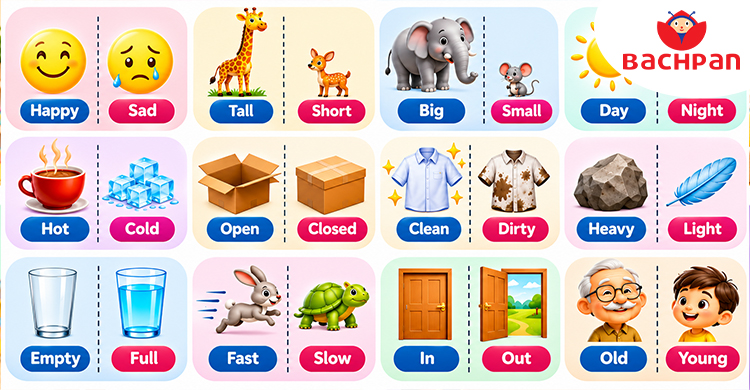
Let us begin with common opposite words in English that children hear and use every single day. These simple antonyms for kids to learn form the building blocks of early communication, helping little ones describe objects, feelings, and surroundings at home and in the classroom.
| No. | Word | Opposite |
|---|---|---|
| 1 | Big | Small |
| 2 | Happy | Sad |
| 3 | Hot | Cold |
| 4 | Good | Bad |
| 5 | Day | Night |
| 6 | Up | Down |
| 7 | In | Out |
| 8 | Open | Closed |
| 9 | Near | Far |
| 10 | Old | New |
| 11 | Fast | Slow |
| 12 | Full | Empty |
| 13 | Clean | Dirty |
| 14 | Wet | Dry |
| 15 | Easy | Difficult |
| 16 | Tall | Short |
| 17 | Rich | Poor |
| 18 | Strong | Weak |
| 19 | Right | Wrong |
| 20 | Same | Different |
2. Opposite Words Related to Size and Shape
Children love comparing the sizes and shapes of their toys, books, and snacks. Learning these describing words helps kids notice how things look and feel around them. This handy list of opposite words for children makes size and shape comparisons super fun and visual.
| No. | Word | Opposite |
|---|---|---|
| 21 | Large | Small |
| 22 | Long | Short |
| 23 | Wide | Narrow |
| 24 | Thick | Thin |
| 25 | Heavy | Light |
| 26 | Deep | Shallow |
| 27 | High | Low |
| 28 | Round | Square |
| 29 | Fat | Slim |
| 30 | Tiny | Huge |
3. Opposite Words Related to Feelings and Behaviour
Understanding emotions and good manners is a vital part of growing up. These opposite words help children express how they feel and recognize positive behaviour. Practicing these antonyms for kids also encourages empathy, kindness, and polite habits in daily conversations.
| No. | Word | Opposite |
|---|---|---|
| 31 | Kind | Cruel |
| 32 | Brave | Cowardly |
| 33 | Polite | Rude |
| 34 | Friendly | Unfriendly |
| 35 | Calm | Agitated |
| 36 | Generous | Selfish |
| 37 | Honest | Dishonest |
| 38 | Cheerful | Gloomy |
| 39 | Gentle | Rough |
| 40 | Patient | Impatient |
4. Opposite Words Related to Time and Position
Knowing where things are placed and when activities happen helps children follow daily routines smoothly. These basic English vocabulary words for kids introduce ideas of direction, order, and time—making opposite words for nursery and kindergarten lessons easy to grasp during playtime and school.
| No. | Word | Opposite |
|---|---|---|
| 41 | Morning | Evening |
| 42 | Before | After |
| 43 | Early | Late |
| 44 | First | Last |
| 45 | Start | Finish |
| 46 | Here | There |
| 47 | Above | Below |
| 48 | Inside | Outside |
| 49 | Front | Back |
| 50 | Left | Right |
5. Opposite Words Related to Actions
Little learners are always on the move, which makes action words exciting to explore. Pairing actions with their opposites helps children connect movement with meaning. These common English opposite words for beginners are wonderful for active games, classroom instructions, and lively storytelling sessions.
| No. | Word | Opposite |
|---|---|---|
| 51 | Come | Go |
| 52 | Give | Take |
| 53 | Buy | Sell |
| 54 | Push | Pull |
| 55 | Laugh | Cry |
| 56 | Win | Lose |
| 57 | Remember | Forget |
| 58 | Sit | Stand |
| 59 | Arrive | Depart |
| 60 | Build | Destroy |
6. Opposite Words Related to Nature and Temperature
Stepping outdoors gives children endless chances to observe weather, textures, and sounds. These English opposite words connect early learning with nature, helping kids describe sunny mornings, cool breezes, or sweet fruits while building their basic opposite words vocabulary naturally.
| No. | Word | Opposite |
|---|---|---|
| 61 | Warm | Cool |
| 62 | Sunny | Cloudy |
| 63 | Bright | Dark |
| 64 | Fresh | Stale |
| 65 | Soft | Hard |
| 66 | Sweet | Bitter |
| 67 | Smooth | Rough |
| 68 | Noisy | Quiet |
| 69 | Clear | Cloudy |
| 70 | Daytime | Night-time |
7. More Useful Opposite Words for Kids
Once children master the basics, they are ready for slightly richer word pairs that boost reading and writing skills. This extended opposite words list introduces more words and beyond, giving growing learners the confidence to understand stories and express clearer thoughts.
| No. | Word | Opposite |
|---|---|---|
| 71 | Accept | Reject |
| 72 | Always | Never |
| 73 | Alive | Dead |
| 74 | Asleep | Awake |
| 75 | Begin | End |
| 76 | Borrow | Lend |
| 77 | Cheap | Expensive |
| 78 | Increase | Decrease |
| 79 | Public | Private |
| 80 | Safe | Dangerous |
| 81 | Simple | Complex |
| 82 | Victory | Defeat |
| 83 | Visible | Invisible |
| 84 | Include | Exclude |
| 85 | Arrive | Leave |
| 86 | Connect | Disconnect |
| 87 | Enter | Exit |
| 88 | Expand | Contract |
| 89 | Possible | Impossible |
| 90 | Present | Absent |
| 91 | Remember | Forget |
| 92 | Maximum | Minimum |
| 93 | Success | Failure |
| 94 | Ancient | Modern |
| 95 | Advance | Retreat |
| 96 | Attack | Defend |
| 97 | Create | Destroy |
| 98 | Empty | Filled |
| 99 | Import | Export |
| 100 | Major | Minor |
| 101 | Positive | Negative |
| 102 | Permanent | Temporary |
| 103 | Reward | Punishment |
| 104 | Thick | Thin |
| 105 | Truth | Lie |
Opposite Words Used in Simple Sentences
Seeing opposite words used in everyday sentences helps children understand how words work together in real life. Instead of memorizing isolated lists, young learners grasp context much faster when they read easy opposite words for kids with examples. Practicing short sentences builds stronger English grammar skills and helps kids speak clearly and confidently every day.
Reading stories is another effective way to help children understand how words are used in different contexts. Parents can explore these short moral stories for kids to introduce new vocabulary through simple and meaningful examples.
10 Easy Sentences with Opposite Words
Read these ten simple sentences aloud with your child to highlight contrasting word meanings. Pointing out easy opposite words for kids inside short, relatable examples turns everyday reading into a joyful vocabulary-building habit—especially when practising opposite words for kindergarten.
| No. | Sentence | Opposite Words |
|---|---|---|
| 1 | The elephant is big, but the mouse is small. | Big – Small |
| 2 | The ice is cold, but the soup is hot. | Cold – Hot |
| 3 | The rabbit is fast, but the tortoise is slow. | Fast – Slow |
| 4 | My room is clean, but the garage is dirty. | Clean – Dirty |
| 5 | The glass is full, but the bottle is empty. | Full – Empty |
| 6 | The sun is bright, but the room is dark. | Bright – Dark |
| 7 | The box is heavy, but the bag is light. | Heavy – Light |
| 8 | The shop is near, but the school is far. | Near – Far |
| 9 | The door is open, but the window is closed. | Open – Closed |
| 10 | The baby is awake, but the puppy is asleep. | Awake – Asleep |
Fun Activities to Teach Opposite Words to Kids
Wondering how to teach opposite words to kids without boring drills? Playful hands-on games make antonyms for kids memorable, joyful, and exciting for curious young learners at home or school.
Another enjoyable way to build vocabulary and thinking skills is through What Am I riddles for preschoolers, which encourage children to understand clues, recognise familiar words, and guess the correct answers.
Match the Opposite Word Pairs
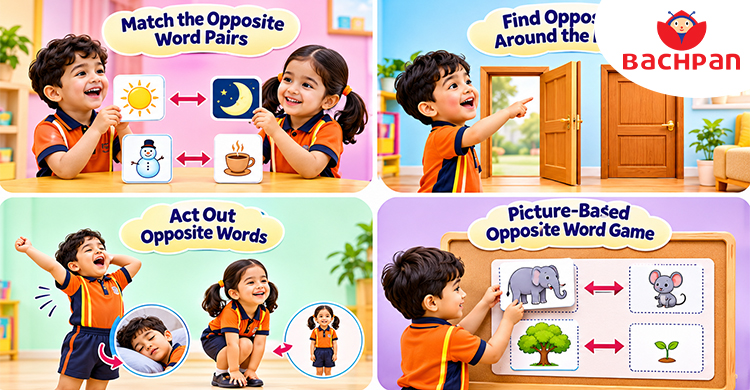
Write basic opposite words on colorful paper cards and spread them across a table. Ask your child to match contrasting word pairs like hot and cold or day and night. This simple matching game strengthens memory, sharpens focus, and makes learning opposite words for preschoolers feel like playtime.
Parents and teachers can make vocabulary practice more engaging by combining word-matching games with other preschool activities for kids that encourage learning through play.
Find Opposites Around the House
Everyday objects can become interesting learning resources. Ask children to look around the house and find things that show opposite qualities.
For example:
- A big cushion and a small cushion.
- An open door and a closed door.
- A full glass and an empty glass.
- A clean table and a dirty table.
This simple game helps children connect new vocabulary with things they see every day.
Parents can extend this simple learning game with other learning activities at home that help children explore everyday concepts through practical experiences.
Act Out Opposite Words
Make learning new words more playful with an action game. Call out a word and encourage children to act out its opposite using simple movements.
For example:
- Say “up” and ask them to move their hands down.
- Say “sit” and ask them to stand.
- Say “fast” and ask them to move slowly.
- Say “laugh” and ask them to pretend to cry.
Children enjoy moving around, and these playful actions make it easier to remember new words.
Picture-Based Opposite Word Game
Visuals make abstract ideas simple for little eyes. Use flashcards or storybooks featuring opposite words with pictures for kids, such as a tall giraffe next to a short rabbit. Asking children to spot differences in pictures boosts observation skills and reinforces common opposite words in English naturally.
Opposite Words Worksheet for Kids
A little practice can help children remember what they have learned. Once they are familiar with different word pairs, encourage them to solve this simple worksheet.
These questions are suitable for beginners and can be used for classroom practice or learning at home.
| No. | Question | Answer |
|---|---|---|
| 1 | What is the opposite of Happy? | Sad |
| 2 | What is the opposite of Up? | Down |
| 3 | What is the opposite of Clean? | Dirty |
| 4 | What is the opposite of Fast? | Slow |
| 5 | What is the opposite of Open? | Closed |
| 6 | What is the opposite of Strong? | Weak |
| 7 | What is the opposite of Early? | Late |
| 8 | What is the opposite of Big? | Small |
| 9 | What is the opposite of Hot? | Cold |
| 10 | What is the opposite of Laugh? | Cry |
Opposite Words Quiz for Kids
Test what your child has learned with this fun quiz on opposite words for kids in English. These simple questions will help children recall word pairs, understand their meanings, and practice their vocabulary while making learning more enjoyable.
FAQs About Opposite Words for Kids
Opposite words are pairs of words that express completely different meanings. For instance, big and small, hot and cold, or happy and sad are common examples. Learning these word pairs helps children recognise differences, understand word meanings, and describe the world around them in a better way.
Another name for opposite words is antonyms. These words have opposite or contrasting meanings. For example, fast and slow, or light and dark, are antonyms.
Here are 10 common examples of opposite words:
Big – Small
Happy – Sad
Hot – Cold
Up – Down
Fast – Slow
Day – Night
Open – Closed
Clean – Dirty
Full – Empty
Strong – Weak
Learning opposite words helps children expand their vocabulary, understand different word meanings, and express themselves more clearly. It also teaches them to recognise differences in the things they see around them. With regular practice, children can strengthen their language skills and become more confident in reading, writing, and everyday communication.
Opposite words, also called antonyms, have contrasting meanings, whereas synonyms are words that have the same or similar meanings.
For example:
Opposites: Happy – Sad
Synonyms: Happy – Cheerful
Conclusion: Help Kids Build Their Vocabulary with Opposite Words
Learning new words does not always have to involve books and worksheets. Simple conversations, picture games, storytelling, and everyday activities can make vocabulary building an enjoyable experience.
With regular practice, opposite words for kids can help children understand word meanings, express their thoughts, and become more confident in using English. Start with familiar words, introduce new pairs gradually, and let children learn at their own pace. After all, little learning moments today can build strong language skills for tomorrow.