



Nouns for Kids: Types of Nouns With Easy Examples
Every sentence we say or write contains some naming words. These naming words are called nouns. A noun is a part of speech that is used by every person in the early stages of learning a language. In this blog, you will find a detailed but simple explanation of what nouns are, different kinds of nouns for kids in English, their examples, and a few practice exercises.
Parents can reinforce early language skills through engaging learning activities for preschoolers at home, including simple naming, matching, and vocabulary games.
What Is a Noun?
A noun is a word that denotes a person, place, animal, thing, or idea. In other words, if you can picture it, name it, or think of it, there’s a good chance that it’s a noun. This noun definition for kids makes it easy to identify nouns as one of the simplest parts of speech to spot.
Noun Examples for Kids
Before diving into the different types, studying nouns examples for kids grouped by what they name is a better way to start. Here’s a simple breakdown to build familiarity.
| Noun Category | Examples |
|---|---|
| Person | boy, teacher, doctor |
| Place | school, park, Delhi |
| Animal | dog, cat, elephant |
| Thing | book, pencil, ball |
| Idea or Feeling | love, kindness, happiness |
Children can practise identifying nouns by naming different parts of the human body. This body parts for kids guide provides another familiar topic for building vocabulary.
Types of Nouns with Examples
Nouns come in several different types, each naming something slightly different. Learning these noun types with examples for kids makes it much easier to recognize and use them correctly.
Common Nouns
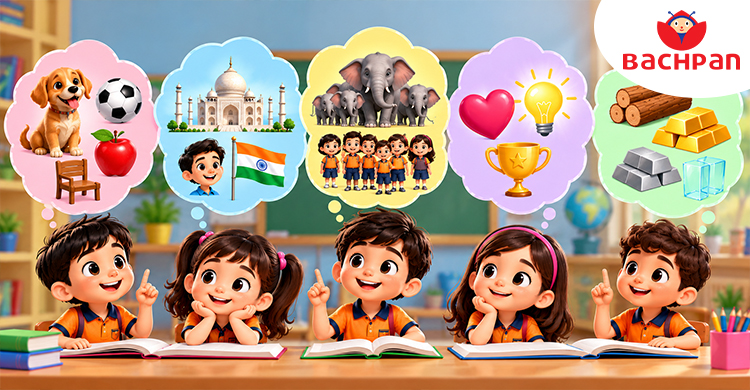
A common noun is a general name for a person, place or thing. It does not refer to a particular person, place or thing. For instance, the words “boy,” “city,” “school” and “book” are common nouns. Common nouns are not capitalized unless they occur at the beginning of a sentence.
Proper Nouns
A proper noun is a word that denotes one particular person, place, or object, and it always begins with a capital letter. For instance, ‘Riya’, ‘Delhi ’, ‘India’, and ‘Monday’. Proper nouns stand for a specific name or term that cannot be replaced with a common noun.
Collective Nouns
A collective noun is used to refer to the group of items or people. The following are examples of collective nouns: team, flock, family, and class. All these examples of collective nouns refer to a group of objects or people.
Abstract Nouns
An abstract noun is a part of speech that denotes the name of an intangible (incorporeal) object, that is, a feeling, a quality that manifests itself in a person, or a concept. Words like kindness, happiness, honesty, love are examples of abstract nouns. Abstract nouns are usually classified as one of the types of common nouns.
Material Nouns
A material noun is used to denote a substance or a material something is made of. Such terms as gold, wood, water, and cotton are examples of material nouns. These words refer to material objects or substances; therefore, they are generally not used to indicate a particular object, although some objects are made from them.
Easy Noun Examples for Kids
Seeing nouns used in real, simple contexts helps children recognize them more naturally in everyday reading and speech.
Nouns for People, Places, Animals and Things
Here are a few more easy noun examples for kids, grouped by category for quick reference and easy learning.
| Category | Easy Examples |
|---|---|
| People | mother, teacher, child, doctor |
| Places | school, park, home, city |
| Animals | dog, cat, lion, rabbit |
| Things | book, bag, pencil, toy |
Nouns in Sentences
Seeing nouns inside full sentences makes them even easier to spot. Here are a few simple examples:
- The boy is playing.
- My mother is cooking.
- The dog is sleeping.
- We went to the park.
- I have a new book.
- The teacher is reading a story.
Reading short moral stories for kids gives children more opportunities to spot nouns used in sentences and build their everyday vocabulary.
Common Nouns and Proper Nouns
The two most common types of nouns that give students the most trouble are common and proper nouns. Examples of both kinds of nouns will help you understand the distinction between them.
| Common Noun | Proper Noun |
|---|---|
| girl | Riya |
| country | India |
| city | Delhi |
| school | Bachpan |
| river | Ganga |
| day | Monday |
Difference Between Common and Proper Nouns
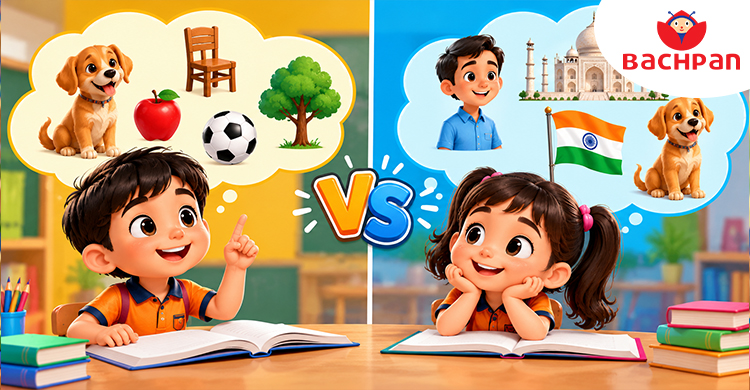
The first difference between the two terms of common and proper nouns is that common nouns are the general names of things, while proper nouns are specific names of objects, persons, or places. For instance, a girl is a common noun, and Riya is a proper noun. The same pattern applies to cities: city is a common noun, and Delhi is the proper noun. The second difference is that writers always capitalize proper nouns, and they can place them anywhere in a sentence. The capitalization and positioning of the proper nouns help identify them and reduce spelling mistakes.
Singular and Plural Nouns
Nouns can also be either singular or plural. Below are further details concerning singular and plural nouns.
Singular Nouns
Singular nouns are used when a speaker or writer refers to one particular person, place, animal, or thing (e.g., cat, book, child). Since singular nouns stand for one object, children have to acquire a vast amount of vocabulary in order to be able to learn the plural forms of these words.
Plural Nouns
Plural nouns are used to refer to more than one person, place, animal, or thing. Most plural nouns are formed by adding the suffix es or s; however, several irregular plural nouns must be practiced, considerably.
| Singular | Plural |
|---|---|
| cat | cats |
| book | books |
| baby | babies |
| box | boxes |
| child | children |
Alongside singular and plural words, children can practise counting objects and reading numbers with this number names 1 to 100 chart.
Noun Practice Exercises for Kids
Practice is the best way to help these noun exercises for kids truly work. Try these simple activities to test what you’ve learned so far.
Parents can make grammar revision more interactive with preschool activities parents can do at home, such as picture-naming games, object hunts, and simple word-matching tasks.
Find the Noun
Read each sentence and identify the noun:
1. The girl sang a song.
2. Our class visited a museum.
3. The baby is sleeping.
4. He kicked the ball.
5. The river flows gently.
Answers: girl/song, class/museum, baby, ball, river.
Identify the Type of Noun
1. Delhi is a big city. → Proper Noun
2. The team won the match. → Collective Noun
3. Kindness is a good quality. → Abstract Noun
Singular or Plural?
Decide whether each word is singular or plural: dogs, child, boxes, baby, children, book.
Answers: dogs (plural), child (singular), boxes (plural), baby (singular), children (plural), book (singular).
Fill in the Blanks
Fill in each blank with a suitable noun:
1. The ________ is barking loudly.
2. My ________ cooked dinner.
3. We visited the ________ yesterday.
4. The ________ is reading a book.
Sample Answers: dog, mother, park, teacher.
Nouns for Kids: Quick Revision
Here’s a quick revision table summarizing all the types of nouns for kids covered in this guide.
| Type of Noun | Meaning | Example |
|---|---|---|
| Common Noun | General name | school |
| Proper Noun | Special name | India |
| Collective Noun | Name of a group | team |
| Abstract Noun | Feeling, quality or idea | kindness |
| Material Noun | Name of a material | gold |
FAQs About Nouns for Kids
A noun is a word that refers to a person, place, animal, thing, or idea such as a boy, school, dog, book, and happiness.
The five main types of nouns are common, proper, collective, abstract and material nouns, and each refers to different things.
Some easy examples of nouns include: boy (a person), school (a place), dog (an animal), book (a thing), and kindness (an idea or quality).
A common noun refers to a general person, place, or thing, like a teacher, city, or book.
Proper nouns are specific names for people, animals, places, or organizations, such as Delhi, Riya, India, and so on.
A collective noun is used to refer to a group of things, animals, or people, such as a team, family, or flock.
An abstract noun refers to ideas, emotions, and qualities that cannot be felt or touched, such as kindness, love, and honesty.
Singular nouns refer to one person, place, or thing while plural nouns refer to more than one person, place, or thing; e.g., one cat or two cats, and one child or two children.
Conclusion
Part of understanding how to correctly apply English grammar rules for kids is knowing what a noun is. Nouns are undoubtedly the simplest and most readily available part of speech for kids to learn. Once they can identify people, places, animals, objects, and concepts as nouns and distinguish one from another, correctly reading and writing will become significantly easier for them. And with enough practice using the examples provided and doing the exercises, identifying nouns will become second nature to kids.