


Water Cycle for Kids: Stages, Diagram & Easy Explanation
Have you ever wondered where rain comes from or what happens to water after it dries up in the Sun? These everyday changes are part of a natural process called the water cycle. Learning about the water cycle for kids helps them understand the natural water cycle and how water moves between the Earth and the atmosphere. It also introduces simple science concepts through familiar examples, such as clouds, rainfall, rivers, and puddles. In this blog, you will explore the 4 stages of the water cycle explained with an easy water cycle diagram and a fun experiment to try at home.
What Is the Water Cycle?
The water cycle is the continuous movement of water between the Earth’s surface and the atmosphere. During this process, water travels from oceans, rivers, lakes, and soil into the air. As a result, it forms clouds and returns to the Earth as rain or snow. The Sun’s heat and gravity help drive this natural process. In simple terms, a water cycle explanation for kids makes the process easier to understand by connecting each stage with things children see around them.
Water Cycle Diagram with Labels
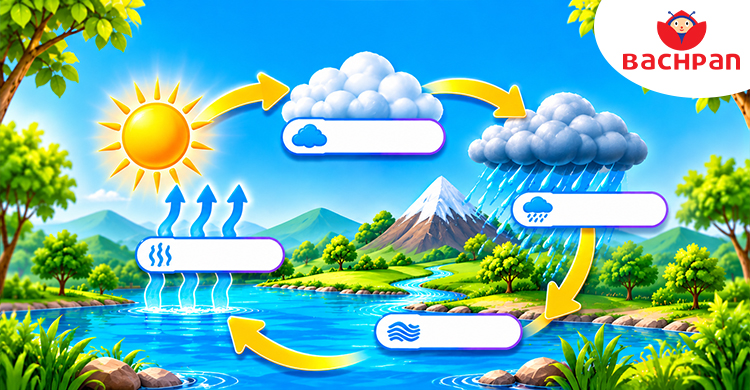
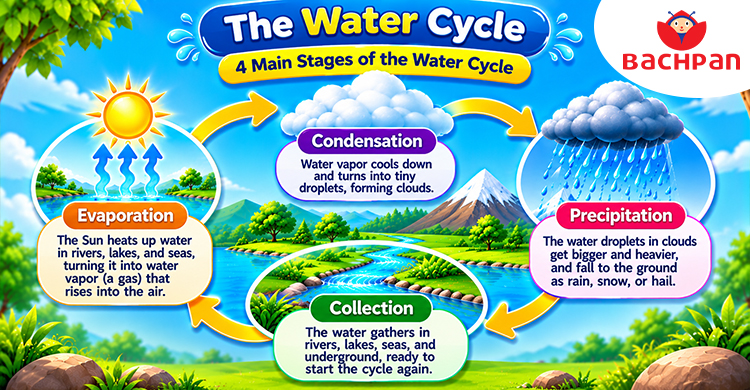
A water cycle diagram shows how water moves through different stages. It uses arrows to explain how water rises, forms clouds, falls as rain, and collects in water bodies. Children can follow the arrows in this water cycle diagram with labels to understand the process and remember the four main stages.
Using diagrams, pictures, and hands-on tasks can make science concepts easier to understand. Parents and teachers can explore these visual learning activities for kids to introduce concepts in an engaging way.
4 Main Stages of the Water Cycle
The 4 stages of the water cycle explain how water travels from the Earth’s surface into the air and returns to the ground. Now, let’s understand these 4 stages of the water cycle through simple explanations and everyday examples that make water cycle science for kids easier to learn.
1. Evaporation
Evaporation happens when the Sun heats water in oceans, rivers, lakes, and puddles. The liquid water slowly changes into an invisible gas called water vapour. This vapour rises into the atmosphere. Have you noticed how a puddle becomes smaller after a sunny day? That happens because some of its water evaporates. The Sun’s heat provides the energy needed for this stage of the water cycle process.
2. Condensation
As water vapour rises higher into the atmosphere, it meets cooler air. It cools down and changes into tiny water droplets. This process is called condensation. Many tiny droplets come together to form clouds. These droplets are so small that they can stay suspended in the air. Condensation also explains why water droplets appear on the outside of a cold glass on a warm day. It is an important stage in cloud formation.
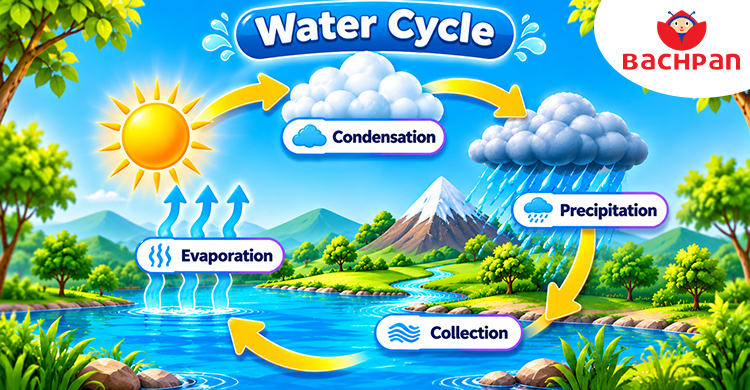
3. Precipitation
Clouds contain tiny water droplets or ice crystals. When these droplets join together and become heavy enough, water falls back to the Earth’s surface. This stage is called precipitation. It can happen in different forms, such as rainfall, snowfall, sleet, or hail. Rain provides water to plants, rivers, lakes, and soil. Some of it also reaches the oceans. Precipitation brings water from the atmosphere back to the Earth.
4. Collection
After precipitation, water collects in oceans, seas, rivers, lakes, ponds, and other water bodies. Some water flows over the land as runoff, while some seeps into the ground and becomes groundwater. Plants and animals also use this water. Eventually, the Sun heats water on the Earth’s surface, and evaporation begins again. This completes one round of the cycle. However, the water cycle never truly stops or has a fixed starting point.
How Does the Water Cycle Work?
The water cycle process involves the continuous movement of water. First, the Sun heats water in oceans, rivers, and lakes. As a result, some of it changes into water vapour and rises into the atmosphere. Next, as the vapour cools, condensation forms clouds. Then, water falls as precipitation, such as rain or snow. After that, it collects in water bodies or enters the ground. Meanwhile, some water flows into rivers through runoff. Finally, the Sun heats this water again, and the process continues. This is how the water cycle works in nature.
Why Is the Water Cycle Important?
The water cycle keeps water moving across the Earth and supports life in many ways. It helps refill rivers, lakes, and groundwater supplies. Rain provides water for crops, forests, animals, and people. The process also plays an important role in weather and climate. Without the natural movement of water, many living things would struggle to survive. Understanding why the water cycle is important for kids also teaches them to value clean water and use it carefully.
Easy Water Cycle Experiment for Kids
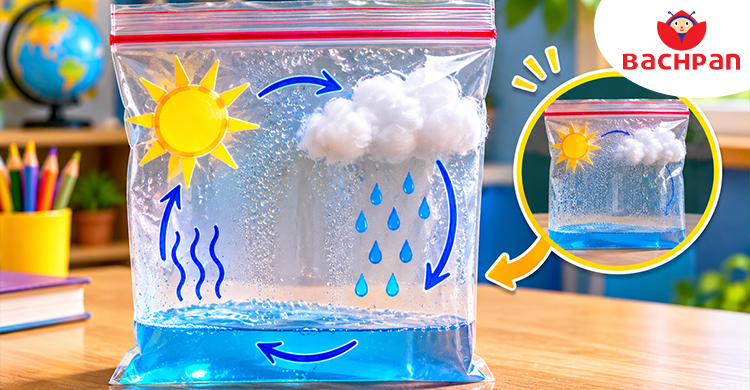
Children understand science better when they can observe it themselves. This water cycle experiment for kids at home and simple water cycle project for school uses a transparent plastic bag to show how water changes and moves. Children can watch tiny droplets appear and travel down the sides of the bag.
Parents can make science learning more engaging by combining simple experiments with other fun learning activities at home that encourage children to observe, explore, and learn through play.
Mini Water Cycle in a Bag
Materials: Resealable transparent plastic bag, a little water, blue food colouring (optional), marker and tape.
Steps:
1. Pour a small amount of water into the bag.
2. Draw the Sun, clouds, and water on the outside.
3. Seal the bag securely.
4. Tape it to a sunny window.
5. Observe the water over time as droplets form inside the bag.
Explanation: The Sun warms the water inside the bag. Some water changes into invisible water vapour through evaporation. When the vapour touches the cooler surface of the bag, it condenses into tiny droplets. As the droplets join together, they move down the plastic surface. This can represent precipitation. The water collects at the bottom again. This experiment is a simplified model of the natural water cycle, not a complete replication of every stage.
Interesting Water Cycle Facts for Kids
Here are some water cycle facts for kids that make this natural process even more fascinating and explain why the water cycle is an interesting topic to explore.
1. Water keeps moving: The same water moves through the natural water cycle again and again. It changes form and location but continues to circulate on Earth.
2. The Sun provides energy: The Sun’s heat helps water evaporate from oceans, lakes, rivers, and other wet surfaces.
3. Plants release water: Plants release water vapour through their leaves. This process is called transpiration.
Understanding transpiration becomes easier when children learn how plants absorb and transport water. Explore these parts of a plant to help children understand how roots, stems, and leaves support plant growth.
4. Clouds contain tiny droplets: Clouds form when water vapour cools and condenses into tiny water droplets or ice crystals.
5. Rain is not the only precipitation: Water can fall from clouds as rain, snow, sleet, or hail.
6. Water exists in three forms: Water can exist as a liquid, solid ice, or gas called water vapour.
7. The cycle has no fixed beginning: Evaporation, condensation, precipitation, and collection continue in a repeating process. There is no single starting or ending point.
Water Cycle Quiz for Kids: Test Your Knowledge!
FAQs About the Water Cycle for Kids
Learning how to explain the water cycle to kids shows that the water cycle in simple words is the continuous movement of water between the Earth and the atmosphere. Water evaporates, forms clouds through condensation, and returns to the ground as rain or snow. It then collects in rivers, lakes, oceans, and underground before the process begins again.
The 4 stages of the water cycle are evaporation, condensation, precipitation, and collection. Evaporation changes liquid water into vapour, condensation forms clouds, precipitation brings water back to the Earth, and collection allows it to gather in water bodies and underground.
Clouds form through condensation. Water evaporates from the Earth’s surface and rises into the atmosphere as water vapour. When the vapour cools, it changes into tiny water droplets or ice crystals. These droplets and crystals gather to form clouds.
Evaporation changes liquid water into water vapour, usually with the help of heat. Condensation is the opposite process. It changes water vapour into tiny liquid water droplets when the vapour cools. Both processes play an important role in cloud formation and the water cycle.
The Sun provides the heat energy that helps water evaporate from oceans, rivers, lakes, and other surfaces. This water vapour rises into the atmosphere and later forms clouds through condensation. Without the Sun’s energy, the water cycle would not work in the same way.
Conclusion: Understanding the Water Cycle for Kids
Understanding the water cycle for kids makes it easier to see how nature keeps water moving around the Earth. In particular, the four main stages—evaporation, condensation, precipitation, and collection—explain this continuous process in simple terms. Moreover, children can learn these concepts through labelled diagrams, everyday examples, and fun experiments. At the same time, the water cycle for preschoolers helps them understand that water is a valuable natural resource. Therefore, encourage children to observe clouds, rainfall, and puddles around them. Through these simple observations, children can develop a greater interest in science and feel inspired to save water.
Parents can build on this curiosity with other learning activities for preschoolers at home that introduce basic concepts through observation and practical experiences.