



Parts of a Plant for Kids: 7 Parts, Names, Functions & Diagram
On this planet, every plant, regardless of its size, is made up of the same basic parts, each of which serves a specific purpose. This blog, Parts of a Plant for Kids, examines each of the 7 parts of a plant in detail. It includes easy-to-remember names, descriptions of their functions, a labelled diagram, and a worksheet for learners to learn all about plant structure.
Just as children learn to identify body parts for kids and understand their functions, learning about plant parts helps them understand how living things are structured.
What Are the 7 Parts of a Plant?
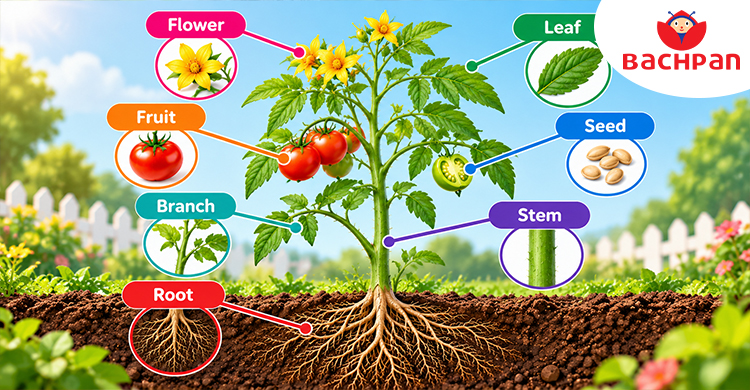
Before looking at each part in detail, here’s a quick overview of the 7 parts of a plant and what each one does, matching the labeled diagram given.
| Plant Part | Main Function |
|---|---|
| Roots | Absorb water and minerals and anchor the plant |
| Stem | Supports the plant and transports water and nutrients |
| Leaves | Make food for the plant through photosynthesis |
| Flowers | Help many plants reproduce and form seeds |
| Fruits | Protect seeds and may help disperse them |
| Seeds | Can grow into new plants under suitable conditions |
| Branches | Support leaves, flowers, and fruits in many plants |
These are the plant parts and their names that children commonly learn in plant biology. Understanding the 7 parts of a plant and their functions for kids makes it easier to identify the different parts and explain how they help a plant survive.
Parts of a Plant and Their Functions
Now let’s look at plant parts and their functions in a bit more detail, covering what each part does and why it matters to the survival of any plant.
Roots
Roots, which are located in the ground, have two essential functions, which include taking up water and minerals from the soil and also giving plants support so that they do not fall. Roots are required by plants to absorb nutrients, without which plants cannot survive.
Stem
The stem is the stalk of the plant that supports the leaves, flowers, and fruits, taking them up towards the sun. It also acts as a way to transport water and minerals from the roots to the top part of the plant.
Leaves
Plants have leaves that enable them to perform photosynthesis, which is a process that produces energy through the utilization of sunlight, water, and carbon dioxide from the air. This is precisely why leaves are among the most vital organs of a plant.
Children can also learn about body organs for kids to understand how different parts of the human body perform specific functions, just as leaves and roots have distinct roles in plants.
Flowers
Flowers are a vibrant part of a plant, and it plays an important role in that plant’s reproductive cycle. Flowers help plants reproduce by producing seeds, which is commonly aided by insects transferring pollen from plant to plant.
Fruits
After a flower has been successfully pollinated, it can grow into a fruit. Fruits protect the seeds they contain and help them adhere to passersby, whether animals or the wind, so that they can spread to new locations and grow.
Seeds
Seeds are tiny; still, they possess all the qualities that would allow a new plant to grow out of them. With the right amount of water, heat, and soil, a seed will grow into a new plant.
Branches
Branches grow off of the main trunk of a plant to support leaves, flowers, and fruits. They spread out the leaves that came from the trunk to allow them to absorb more sunlight.
Parts of a Plant Diagram With Labels
The parts of a plant diagram given in this blog shows you where exactly each of these 7 parts of a plant is, from the roots that are underground up to the flower, fruit, and seeds on top, connected by the stem and branches in between.
An easy diagram of parts of a plant is particularly useful for classroom learning, science projects, and revision. When children look at parts of a plant with names and pictures, they can understand the structure more clearly and learn to identify the parts of a flowering plant.
How Do the Different Parts of a Plant Work Together?
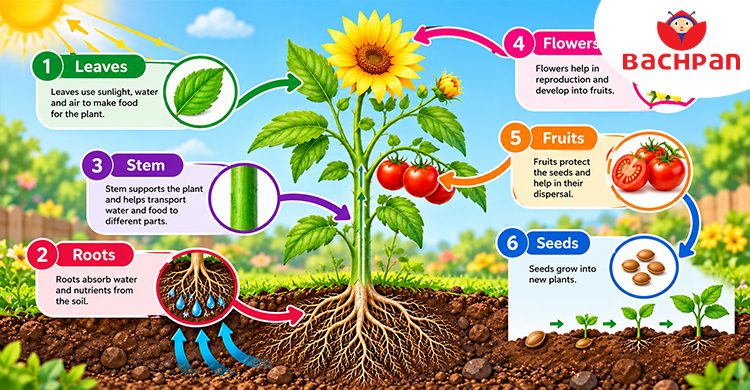
How do different parts of a plant work together is an important question for children learning about plant growth. Every part of a plant works together as a connected system, with each part depending on the others.
- Roots absorb water and minerals from the soil.
- The stem transports water and nutrients to other parts.
- Leaves use sunlight, water, and carbon dioxide to make food.
- Flowers help many plants reproduce.
- Fruits protect seeds and may help disperse them.
- Seeds can grow into new plants under suitable conditions.
- Branches support leaves, flowers, and fruits.
This simple sequence explains how the plant parts and functions work together:
Roots absorb water → Stem transports water → Leaves make food → Plant grows and reproduces.
Understanding this process helps children see that each part has a specific role. The 7 parts of a plant and their functions for kids are easier to remember when students learn how they work together rather than studying each part separately.
What Does a Plant Need to Grow?
Beyond its own parts, a plant needs a few essential things from its environment to grow well: sunlight for making food, water absorbed through the roots, air for photosynthesis and respiration, and nutrients from healthy soil. Give a plant these basics, and its roots, stem, leaves, and eventually flowers, fruits, and seeds can all do their jobs properly.
Parts of a Plant Worksheet for Kids
Testing what you’ve learned is one of the best ways to make it stick. Try these quick activities covering plant parts for kids. This parts of a plant worksheet for kids helps children revise the names, locations, and functions of the different plant parts.
These activities can also be adapted for parts of a plant for kindergarten, with simple matching exercises and picture-based questions. They are useful for classroom practice, homework, and revision.
Parents can reinforce this lesson with learning activities for preschoolers at home, such as observing a real plant, matching plant-part names to pictures, and drawing a labelled plant.
Label the Parts of a Plant
Here’s the same plant, this time with its parts numbered instead of named. See if you can match each number to the correct part.
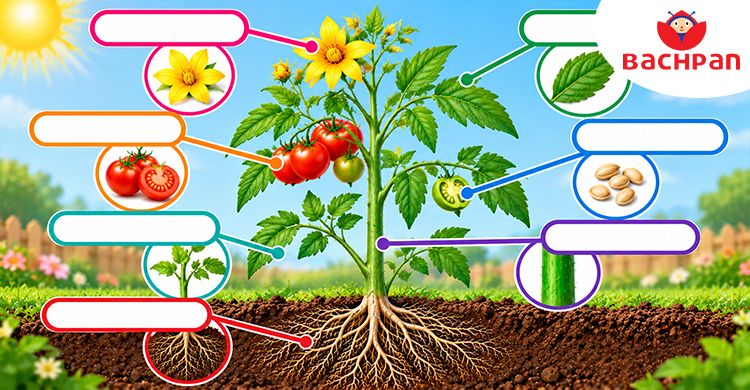
Match the Plant Part With Its Function
| Plant Part | Main Function |
|---|---|
| Roots | Absorb water and minerals and anchor the plant |
| Stem | Supports the plant and transports water and nutrients |
| Leaves | Make food for the plant through photosynthesis |
| Flowers | Help many plants reproduce and form seeds |
Fill in the Blanks
1. The _____ absorb water from the soil.
2. The _____ makes food for the plant.
3. A new plant can grow from a _____.
4. The _____ protects the seeds and may help them travel.
5. The _____ supports the plant and carries water upward.
Answers: roots, leaves, seed, fruit, stem.
Teachers can extend the lesson with preschool activities by category, including nature observation, drawing, and simple hands-on science tasks.
FAQs About Parts of a Plant
The 7 parts of a plant are the roots, stem, leaves, flowers, fruits, seeds, and branches, each playing a distinct role in the plant’s growth and survival.
Roots take in water and anchor the plant; the stem holds the plant up and transports nutrients; leaves produce food; flowers assist with reproduction; fruits protect the seeds; seeds grow into new plants; and branches support leaves, flowers, and fruits. These are the main functions of plant parts.
The roots soak up water and minerals from the soil.
The leaves make the food for the plant.
The stem provides support and transport services within the plant.
A pollinated flower can become a fruit.
A seed is the vessel that contains all the material necessary to produce a plant under the right conditions of water, heat, etc.
They are the site of photosynthesis, which allows a plant to synthesize carbohydrates using sunlight, water, and carbon dioxide.
Conclusion
Knowing the 7 parts of a plant and their functions, including roots, stem, leaves, flowers, fruits, seeds, and branches, helps children to comprehend how plants grow, thrive, and reproduce. By providing a diagram of the parts of a plant with labels, the functions of each part, and the worksheet activities, children will be able to obtain a new perspective on plants and their role in our environment. This information may be beneficial when completing projects for school and for having a better overall knowledge of how plants work and grow.