



Roman Numerals for Kids: Easy Chart, Rules and Examples
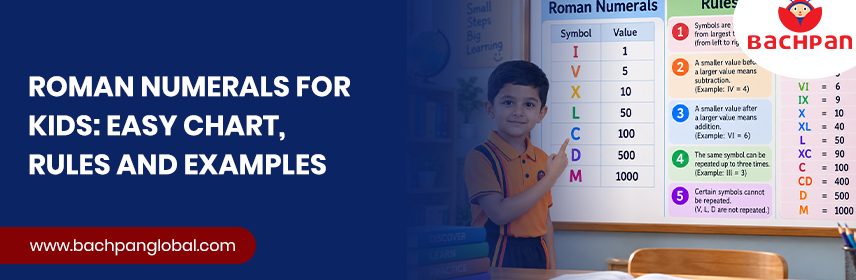
Learning numbers becomes even more exciting when children discover different ways to write them. Roman numerals for kids are a fun and important part of early mathematics that helps children recognise number patterns and understand how numbers were written long ago. From clocks and book chapters to sporting events and movie titles, Roman numerals are still used in many places today. This simple guide will help children learn Roman numerals through easy charts, clear explanations, and everyday examples. With regular practice, Roman numbers for kids become easy to understand and remember.
Quick Roman Numerals Chart for Kids
To help children learn Roman numerals quickly and easily, here is a simple chart covering the most commonly used numbers. Parents and teachers can use this table for daily practice and revision.
Roman Numeral Symbols Every Child Should Know
| Roman Numeral | Number |
|---|---|
| I | 1 |
| V | 5 |
| X | 10 |
| L | 50 |
| C | 100 |
| D | 500 |
| M | 1000 |
Roman Numerals 1 to 10
These are the first Roman numerals children should learn. Understanding these basic numbers makes it easier to build larger Roman numerals later.
| Number | Roman Numeral |
|---|---|
| 1 | I |
| 2 | II |
| 3 | III |
| 4 | IV |
| 5 | V |
| 6 | VI |
| 7 | VII |
| 8 | VIII |
| 9 | IX |
| 10 | X |
Roman Numerals 11 to 20
Once children understand the symbols I, V, and X, they can easily learn the numbers from 11 to 20 by combining these symbols.
| Number | Roman Numeral |
|---|---|
| 11 | XI |
| 12 | XII |
| 13 | XIII |
| 14 | XIV |
| 15 | XV |
| 16 | XVI |
| 17 | XVII |
| 18 | XVIII |
| 19 | XIX |
| 20 | XX |
Roman Numerals 21 to 50
This chart helps children understand how Roman numerals continue beyond 20 by combining familiar symbols in different ways.
| Number | Roman Numeral | Number | Roman Numeral |
|---|---|---|---|
| 21 | XXI | 36 | XXXVI |
| 22 | XXII | 37 | XXXVII |
| 23 | XXIII | 38 | XXXVIII |
| 24 | XXIV | 39 | XXXIX |
| 25 | XXV | 40 | XL |
| 26 | XXVI | 41 | XLI |
| 27 | XXVII | 42 | XLII |
| 28 | XXVIII | 43 | XLIII |
| 29 | XXIX | 44 | XLIV |
| 30 | XXX | 45 | XLV |
| 31 | XXXI | 46 | XLVI |
| 32 | XXXII | 47 | XLVII |
| 33 | XXXIII | 48 | XLVIII |
| 34 | XXXIV | 49 | XLIX |
| 35 | XXXV | 50 | L |
Roman Numerals 51 to 100
Children can use the same rules of addition and subtraction to learn larger Roman numerals up to 100.
| Number | Roman Numeral | Number | Roman Numeral |
|---|---|---|---|
| 51 | LI | 76 | LXXVI |
| 52 | LII | 77 | LXXVII |
| 53 | LIII | 78 | LXXVIII |
| 54 | LIV | 79 | LXXIX |
| 55 | LV | 80 | LXXX |
| 56 | LVI | 81 | LXXXI |
| 57 | LVII | 82 | LXXXII |
| 58 | LVIII | 83 | LXXXIII |
| 59 | LIX | 84 | LXXXIV |
| 60 | LX | 85 | LXXXV |
| 61 | LXI | 86 | LXXXVI |
| 62 | LXII | 87 | LXXXVII |
| 63 | LXIII | 88 | LXXXVIII |
| 64 | LXIV | 89 | LXXXIX |
| 65 | LXV | 90 | XC |
| 66 | LXVI | 91 | XCI |
| 67 | LXVII | 92 | XCII |
| 68 | LXVIII | 93 | XCIII |
| 69 | LXIX | 94 | XCIV |
| 70 | LXX | 95 | XCV |
| 71 | LXXI | 96 | XCVI |
| 72 | LXXII | 97 | XCVII |
| 73 | LXXIII | 98 | XCVIII |
| 74 | LXXIV | 99 | XCIX |
| 75 | LXXV | 100 | C |
Quick Reference Chart for Common Roman Numerals
This quick reference table is useful for revision and helps children remember the most commonly used Roman numerals.
| Number | Roman Numeral |
|---|---|
| 1 | I |
| 5 | V |
| 10 | X |
| 20 | XX |
| 30 | XXX |
| 40 | XL |
| 50 | L |
| 60 | LX |
| 70 | LXX |
| 80 | LXXX |
| 90 | XC |
| 100 | C |
| 500 | D |
| 1000 | M |
Now that children are familiar with the Roman numerals chart, let’s understand what Roman numerals are, how they were created, and the simple rules used to write them correctly.
What Are Roman Numerals?
Roman numerals are a number system that uses letters from the English alphabet to represent different numbers. Instead of writing numbers like 1, 5, or 10, this system uses symbols such as I, V, and X.
Where Did Roman Numerals Come From?
Roman numerals were first used in Ancient Rome more than two thousand years ago. Before the number system we use today became common, people relied on these symbols for counting, trading, writing dates, and keeping records. Today, Roman numeral symbols are still taught because they are an important part of mathematics and history.
Why Do We Still Use Roman Numerals Today?
Even though we mostly use regular numbers in everyday life, Roman numerals can still be seen in many places. They appear on clocks, in book chapters, on monuments, in movie sequels, and at important events. Learning Roman numerals helps children recognise these symbols wherever they see them and understand their meaning with confidence.
Roman Numeral Symbols Every Child Should Know
Every Roman numeral is made using seven basic symbols. Learning these symbols helps children read, write, and understand larger Roman numerals with confidence.
I = 1
The symbol I represents the number 1. It is the simplest Roman numeral and is used in many number combinations. Children can start with I (1) and then learn II (2) and III (3). Learning I first helps children understand how Roman numerals are formed.
V = 5
The symbol V stands for 5. It is commonly used with I to make numbers such as IV (4), VI (6), VII (7), and VIII (8). Understanding how V works with I helps children recognise simple number patterns and improves their Roman numerals conversion skills.
X = 10
The symbol X represents 10. It is used to form numbers from 10 onwards, such as XI (11), XV (15), XX (20), and XXX (30). Learning X helps children understand how larger numbers are created and makes writing Roman numerals much simpler.
L = 50
The symbol L stands for 50. It is introduced after children become comfortable with smaller numerals. L is used to write numbers such as LI (51), LV (55), and LX (60). It also helps children confidently read Roman numerals 1 to 100.
C = 100
The symbol C represents 100. Although children usually begin with smaller numbers, learning C helps them recognise larger Roman numerals. It is commonly seen in history books or educational materials, making it an important symbol for Roman numerals for kids.
D = 500
The symbol D stands for 500. While it is not used often in early learning, children should know its value as part of the complete Roman numeral system. Understanding D helps build a stronger understanding of Roman numeral symbols and prepares children for advanced number concepts.
M = 1000
The symbol M represents 1000 and is the largest of the seven basic symbols. It is often used to write years and large numbers. Children may notice M on monuments, important buildings, or historical dates, helping them connect Roman numbers for kids with real-life examples.
Rules for Writing Roman Numerals
Learning a few simple Roman numeral rules helps children read and write Roman numerals correctly. Once they understand these patterns, writing larger numbers becomes much easier.

Rule 1: Repeat Symbols Up to Three Times
Some Roman numeral symbols can be repeated to increase their value. For example, II means 2 and III means 3. However, a symbol should not be repeated more than three times in a row. This is one of the most important Roman numerals rules and examples for children to remember.
Rule 2: Smaller Numbers Before Larger Numbers Mean Subtraction
When a smaller numeral is written before a larger one, its value is subtracted. For example, IV means 4 because 1 is subtracted from 5, while IX means 9 because 1 is subtracted from 10. Understanding this rule is an important part of Roman numerals conversion.
Rule 3: Smaller Numbers After Larger Numbers Mean Addition
If a smaller numeral comes after a larger one, the values are added together. For example, VI equals 6 because 5 + 1 = 6, and XV equals 15 because 10 + 5 = 15. This is one of the easiest Roman numeral rules for children to understand.
Rule 4: Certain Symbols Cannot Be Repeated
Some Roman numeral symbols should never be repeated. The symbols V, L, and D can appear only once in a numeral. For example, VV is incorrect. Instead, the correct numeral for 10 is X. Following this rule helps children avoid common writing mistakes.
Rule 5: Use the Largest Value First Whenever Possible
Roman numerals are usually written by placing the largest value first, followed by smaller values. For example, VIII represents 8 because it combines 5, 1, 1, and 1. Learning this pattern makes how to write Roman numerals much easier for beginners.
Easy Roman Numeral Examples for Kids
The best way to understand Roman numerals is through simple examples. These Roman numeral examples show children how addition and subtraction work while helping them recognise common number patterns. Practising these examples regularly makes learning easier and more enjoyable.
Numbers Using Addition Rules
When a smaller numeral comes after a larger one, the values are added together.
Some easy examples include:
- VI = 6 (5 + 1)
- VII = 7 (5 + 2)
- VIII = 8 (5 + 3)
- XI = 11 (10 + 1)
- XV = 15 (10 + 5)
These examples help children understand one of the most basic Roman numeral rules.
Numbers Using Subtraction Rules
Sometimes a smaller numeral is written before a larger one. In this case, the smaller value is subtracted.
For example:
- IV = 4 (5 − 1)
- IX = 9 (10 − 1)
- XL = 40 (50 − 10)
- XC = 90 (100 − 10)
These examples provide a simple explanation of Roman numerals and help children remember subtraction patterns easily.
Roman Numerals from 1 to 20 Examples
Children can strengthen their understanding by reading and writing the first twenty Roman numerals every day. Practising I to XX improves speed and confidence while helping them recognise patterns. This is also an excellent way to revise Roman numerals 1 to 50 for kids before moving on to larger numbers.
Practice Examples with Answers
Here are a few practice questions for quick revision:
- Write 12 in Roman numerals. Answer: XII
- Write 18 in Roman numerals. Answer: XVIII
- What number does XXV represent? Answer: 25
- What number does XL represent? Answer: 40
- Write 99 in Roman numerals. Answer: XCIX
These simple exercises help children improve their Roman numerals conversion skills and build confidence through regular practice. Parents and teachers can also include a Roman numerals worksheet as part of daily revision to reinforce learning.
Fun Ways to Teach Roman Numerals to Kids
Instead of memorising symbols, parents and teachers can include simple games and creative activities in everyday learning. These Roman numerals learning activities make it easier to teach Roman numerals to kids, improve recall, and keep children interested while practising.
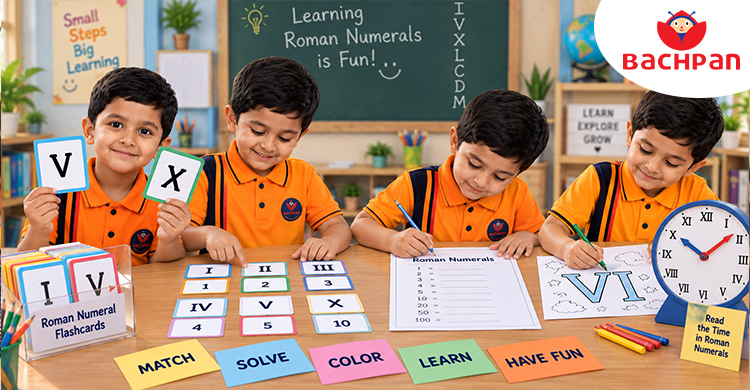
Roman Numeral Flashcards
Flashcards are a simple and effective way to help children recognise Roman numerals quickly. Write the Roman numeral on one side and the number on the other, then ask children to guess the correct answer. Regular practice with flashcards helps children to learn Roman numerals while improving memory and confidence.
Matching Games
Matching games make learning more enjoyable by encouraging children to pair Roman numerals with the correct numbers. For example, children can match XV with 15 or XL with 40. These fun activities strengthen number recognition and provide a simple explanation of Roman numerals through play.
Matching and sorting are simple ways to make number learning more engaging. Explore these types of preschool activities for kids by category for more age-appropriate ideas.
Worksheets and Coloring Activities
A Roman numerals worksheet is a great way to reinforce classroom learning. Children can trace, write, colour, and solve simple exercises while practising Roman numerals. Colouring activities also improve focus and make revision more engaging, helping children remember symbols with ease.
Tracing, writing, and colouring also give children opportunities to strengthen hand control while learning. Try these fine motor activities for preschoolers at home for more hands-on ideas.
Clock Reading Activities
Many traditional clocks use Roman numerals instead of regular numbers. Asking children to read the time on these clocks helps them identify symbols naturally. This everyday activity strengthens their understanding of Roman numerals for students while showing how Roman numerals are used in real life.
Parents can extend Roman numeral practice with other playful learning ideas at home. Explore these best learning activities for preschoolers at home to make learning more interactive and enjoyable.
Common Roman Numeral Mistakes Kids Make
While learning Roman numerals, children may make a few common mistakes. Understanding these errors early helps them apply the Roman numerals rules correctly and build confidence. With regular guidance and practice, these mistakes gradually become easy to avoid.
Writing Four as IIII Instead of IV
One of the most common mistakes is writing IIII instead of IV for the number 4. According to Roman numerals rules, when a smaller numeral comes before a larger one, it is subtracted. Therefore, IV is the correct way to write 4.
Repeating Symbols Too Many Times
Children sometimes write symbols more than three times, such as IIII or XXXX. However, symbols like I, X, C, and M should not be repeated more than three times in succession. Following this rule makes Roman numerals conversion accurate and easy to understand.
Using Symbols in the Wrong Order
Placing symbols in the wrong sequence can completely change a number’s value. For example, VX is incorrect because Roman numerals follow a specific order. Learning how to write Roman numerals correctly helps children avoid such mistakes and write numbers confidently.
Confusing Addition and Subtraction Rules
Some children find it difficult to decide whether they should add or subtract values. Remembering one simple rule helps—when a smaller numeral comes after a larger one, add the values; when it comes before a larger one, subtract. Practising Roman numerals examples regularly makes this concept much easier.
Where Do We See Roman Numerals in Everyday Life?
Roman numerals appear in many everyday places. Spotting them outside the classroom helps children understand their uses and makes learning more practical and memorable.

Clocks and Watches
Many wall clocks and classic watches display Roman numerals instead of regular numbers. Reading these clocks gives children an opportunity to practise their knowledge while understanding how Roman numerals are used in everyday life.
Book Chapters
Roman numerals are often used to number chapters, introductions, and sections in books. Children may notice headings such as Chapter I or Chapter V. Recognising these symbols helps improve familiarity with the Roman numerals chart through regular reading.
Movie Sequels
Many movies use Roman numerals to show different parts of a series, such as Rocky II or Toy Story IV. Spotting these numerals helps children recognise familiar symbols outside the classroom and reinforces what they have already learned.
Sporting Events
Several major sporting events use Roman numerals to identify editions or championship numbers. For example, the Super Bowl is traditionally numbered using Roman numerals. Seeing these symbols during sports broadcasts helps children understand that Roman numerals are still widely used today.
Tips to Help Kids Learn Roman Numerals Faster
Children learn more effectively when lessons are simple, consistent, and enjoyable. A few small habits can make learning Roman numerals easier while encouraging children to practise with confidence. These tips support long-term understanding rather than memorisation.
Start with Basic Symbols
Begin by teaching the seven basic Roman numeral symbols—I, V, X, L, C, D, and M. Once children know these values, they can easily build larger numbers. A strong foundation makes Roman numerals for kids much easier to understand.
Building foundational skills through simple, age-appropriate learning experiences is an important part of early development. Learn more about the importance of preschool and early childhood education.
Practice Daily
Even five to ten minutes of daily practice can improve confidence and accuracy. Children can read a few Roman numerals, complete a Roman numerals worksheet, or revise using a simple chart. Short and regular practice is more effective than long study sessions.
Use Games and Visual Charts
Learning becomes more enjoyable when children use games, flashcards, puzzles, and an easy Roman numerals chart for kids. Visual learning helps children recognise patterns quickly and makes revision more interactive.
Encourage Real-Life Examples
Parents and teachers can encourage children to identify Roman numerals on clocks, books, buildings, calendars, and television. Relating lessons to everyday life helps children understand Roman numerals for students more naturally and remember them for longer.
FAQs on Roman Numerals for Kids
Roman numerals are a number system that uses letters such as I, V, X, L, C, D, and M to represent numbers. They were first used in Ancient Rome and are still seen on clocks, books, monuments, and special events today.
The seven basic Roman numeral symbols are I (1), V (5), X (10), L (50), C (100), D (500), and M (1000). Every Roman numeral is created by combining these symbols according to simple writing rules.
Children learn best by using a Roman numerals chart, practising with a Roman numerals worksheet, playing matching games, using flashcards, and identifying Roman numerals in everyday life. Regular practice makes learning simple and enjoyable.
Roman numerals continue to be used on clocks, book chapters, movie sequels, monuments, and sporting events. Learning them helps children recognise these symbols and understand their importance in daily life and history.
The Roman numeral for 100 is C. It is one of the seven basic Roman numeral symbols and is commonly used when writing larger Roman numerals.
Conclusion – Making Roman Numerals Easy for Kids
Learning Roman numerals for kids becomes simple when they begin with the basic symbols, understand the writing rules, and practise regularly through fun activities. A clear Roman numerals chart, engaging games, and everyday examples help children build confidence while improving their number skills. With consistent practice and the right guidance from parents and teachers, children can easily master Roman numerals 1 to 100, recognise Roman numerals in daily life, and enjoy learning this timeless number system.