



8 Times Table in Maths: Multiplication Table of 8 for Kids
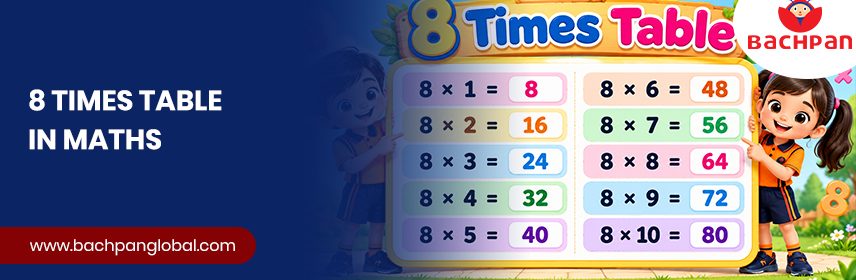
Multiplication tables are one of the most significant mathematical concepts that every child needs to master. The 8 times table is a part of the multiplication table that children find a bit harder to memorize because the numbers grow faster than the 2,3,4 or 5 times tables. We have given the 8 times table along with a few tricks that the kids may use to quickly learn the table. An example of the application of the table, and some example questions, are also given.
Before practising multiplication tables, children can strengthen their number recognition by revising number names 1 to 100.
What Is the 8 Times Table?
The 8 times table displays the answers to the multiplication of 8 with other numbers. It is a quick way of finding out any multiplication of 8, say, 8 × 3 = 24. Another way of thinking about it is that it is simply a shorter way of writing 8 added together three times.
8 Times Table from 1 to 10
Here’s the table of 8 for kids from 1 to 10, the essential starting point every child should learn first before moving on to larger multiples.
| Multiplication | Answer |
|---|---|
| 8 × 1 | 8 |
| 8 × 2 | 16 |
| 8 × 3 | 24 |
| 8 × 4 | 32 |
| 8 × 5 | 40 |
| 8 × 6 | 48 |
| 8 × 7 | 56 |
| 8 × 8 | 64 |
| 8 × 9 | 72 |
| 8 × 10 | 80 |
8 Times Table from 11 to 20
Once the basics feel comfortable, extending to the 8 times table from 1 to 20 helps in building even stronger number fluency.
| Multiplication | Answer |
|---|---|
| 8 × 11 | 88 |
| 8 × 12 | 96 |
| 8 × 13 | 104 |
| 8 × 14 | 112 |
| 8 × 15 | 120 |
| 8 × 16 | 128 |
| 8 × 17 | 136 |
| 8 × 18 | 144 |
| 8 × 19 | 152 |
| 8 × 20 | 160 |
8 Times Table in Words
Reading the 8 times table aloud helps children connect multiplication facts with number names. Use this table to practise saying each multiplication sentence and remembering the answers.
| Number | 8 Times Table in Words |
|---|---|
| 1 | Eight ones are eight |
| 2 | Eight twos are sixteen |
| 3 | Eight threes are twenty-four |
| 4 | Eight fours are thirty-two |
| 5 | Eight fives are forty |
| 6 | Eight sixes are forty-eight |
| 7 | Eight sevens are fifty-six |
| 8 | Eight eights are sixty-four |
| 9 | Eight nines are seventy-two |
| 10 | Eight tens are eighty |
How to Learn the 8 Times Table
A few simple strategies make it much easier to learn the multiplication of 8 for kids without relying purely on memorization.
Use Skip Counting
Skip counting is counting forwards in increments of 8 instead of incrementing by 1 each time. Try reciting the sequence out loud to help in sticking the pattern to memory:
8, 16, 24, 32, 40, 48, 56, 64, 72, 80
Parents can make counting practice more engaging with simple learning activities for preschoolers at home, such as counting objects, sorting items, and playing number games.
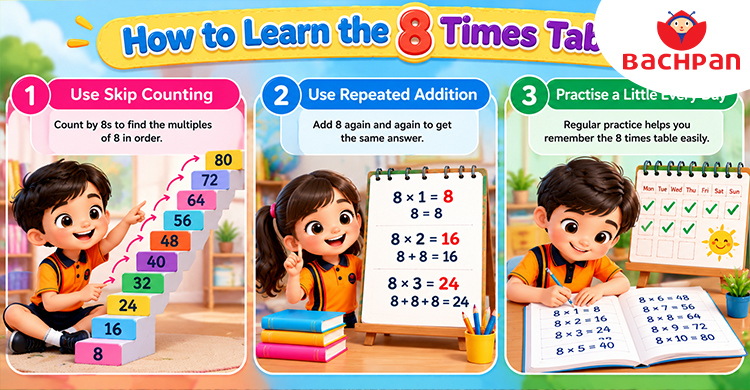
Use Repeated Addition
Since multiplication is nothing more than repeated addition, breaking a multiplicative expression down in this way can make it more intuitive. For example:
8 × 4 = 8 + 8 + 8 + 8 = 32
Practise a Little Every Day
Short, routine practice sessions can be a great alternative to cramming the entire table at once. A touch of repetition every day, in the form of flashcards, counting, or other means, can help a student eventually feel comfortable with the numbers.
Everyday counting games and preschool activities parents can do at home can help younger children build number confidence before progressing to multiplication.
8 Times Table Tricks
These simple 8 times table tricks can make calculations faster and far less intimidating for kids.
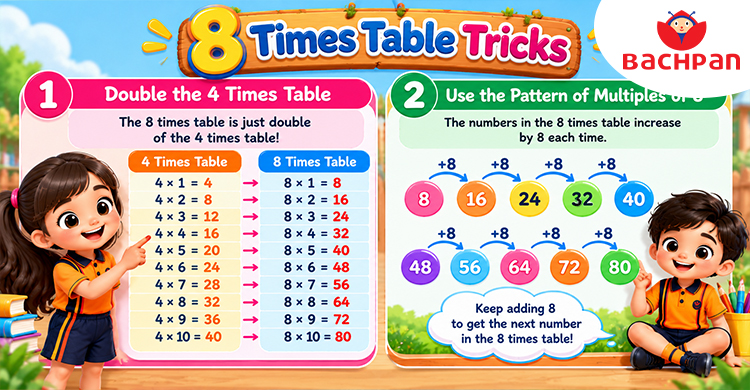
Double the 4 Times Table
Since 8 is twice as big as 4, any multiple of 4 from the table can be doubled to give the corresponding multiple of 8. So, for example, if 4 × 5 = 20, then 8 × 5 is just double 20, which equals 40.
Double a Number Three Times
Since 8 = 2 × 2 × 2, children can multiply a number by 8 by doubling it three times. For example, to calculate 8 × 3, double 3 to get 6, double 6 to get 12, and double 12 to get 24. So, 8 × 3 = 24. This method can help children practise mental maths.
Use the Pattern of Multiples of 8
The answers in the multiplication table of 8 are all even numbers. The ones digit follows a repeating pattern: 8, 6, 4, 2, 0. For example, 8 × 1 = 8, 8 × 2 = 16, 8 × 3 = 24, and 8 × 4 = 32. Recognising this pattern can help children check their answers while practising.
8 Times Table Examples
Seeing the table used in both numbers and real situations makes it far easier to understand and apply.
Simple Multiplication Examples
- 8 × 2 = 16
- 8 × 5 = 40
- 8 × 7 = 56
- 8 × 9 = 72
- 8 × 12 = 96
Everyday Examples
Using real-world examples to teach multiplication makes it easier for students to understand the concept.
For example:
There are 8 pencils in each box. How many pencils are there in 4 boxes?
8 × 4 = 32 pencils
Parents and teachers can also introduce counting through different preschool activities by category, including games, puzzles, and hands-on learning tasks.
8 Times Table Practice Questions
Practice is the best way to make the 8 multiplication facts stick. Try these questions to test what you’ve learned.
For younger learners, writing multiplication answers, tracing numbers, and using number cards alongside fine motor activities for preschoolers at home can make early learning more interactive.
Fill in the Missing Numbers
1. 8 × 2 = ___
2. 8 × 4 = ___
3. 8 × 6 = ___
4. 8 × 8 = ___
5. 8 × 10 = ___
Answers: 16, 32, 48, 64, 80.
Solve the Multiplication Questions
1. 8 × 3 = ___
2. 8 × 7 = ___
3. 8 × 11 = ___
4. 8 × 14 = ___
5. 8 × 20 = ___
Answers: 24, 56, 88, 112, 160.
Word Problems
1. There are 8 apples in each basket. How many apples are in 5 baskets?
2. A classroom has 8 rows with 4 chairs in each row. How many chairs are there?
3. A child reads 8 pages every day. How many pages will the child read in 7 days?
Answers: 40 apples, 32 chairs, 56 pages.
FAQs About the 8 Times Table
The 8 times table shows the results of multiplying 8 by numbers from 1 upward, such as 8 × 1 = 8, 8 × 2 = 16, and so on.
8 × 5 equals 40.
8 × 10 equals 80.
8 × 20 equals 160.
Kids can learn the 8 times table by skip counting, using repeated addition, practising doubling tricks, and revising a few multiplication facts every day.
Since 8 is double 4, doubling any answer from the 4 times table gives the matching answer in the 8 times table, making it quicker to calculate without memorizing everything from scratch.
Conclusion
Children will learn the 8 times table a lot faster if they are helped with a chart to refer to, tricks such as multiplying the 4 times table by 2, practice, and patience. Practicing with the examples and exercises given above will provide children with the confidence and proficiency with multiplying by 8 necessary to tackle harder math.