



Ordinal Numbers 1 to 100 for Kids: List & Examples
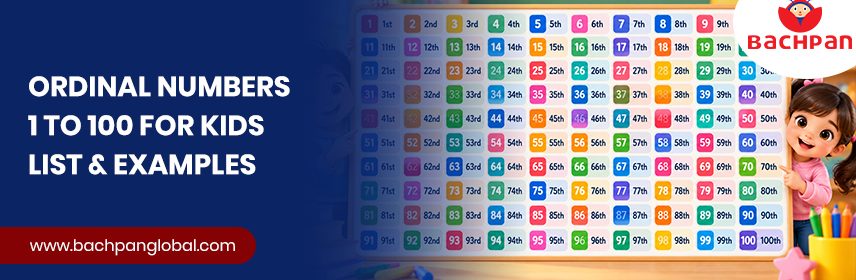
Numbers do not represent only quantities, but they can also signify the position or the order of things; for instance, the result of a competition or the floor where a particular classroom is located. This comprehensive blog on ordinal numbers 1 to 100 for kids covers everything you need, including an in-depth chart, basic rules, examples, and exercises, so children can learn and remember them easily.
What Are Ordinal Numbers?
Ordinal numbers give us the position of a particular thing in a sequence or list. For kids, ordinal numbers refer to “first,” “second,” “third,” and so on. In contrast with cardinal numbers, ordinal numbers express an object’s position, order, or rank.
Cardinal Numbers vs Ordinal Numbers
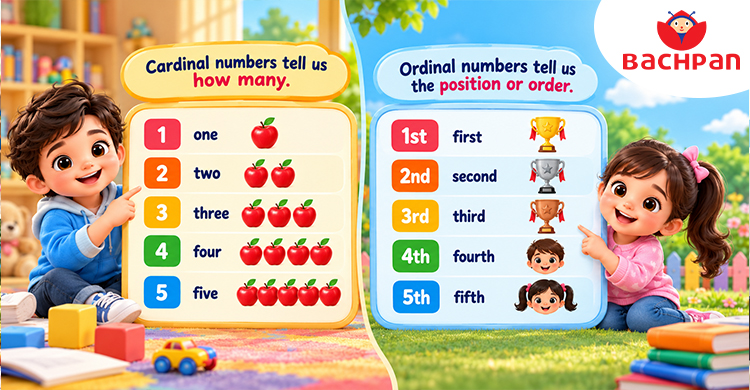
The cardinal numbers (1, 2, 3) represent the quantity of objects, while the ordinal numbers (1st, 2nd, 3rd) represent their position in a series. The table below shows the correlation between the cardinal and ordinal numbers for children for the first ten numbers.
| Cardinal Number | Ordinal Number | Ordinal Name |
|---|---|---|
| 1 | 1st | First |
| 2 | 2nd | Second |
| 3 | 3rd | Third |
| 4 | 4th | Fourth |
| 5 | 5th | Fifth |
| 6 | 6th | Sixth |
| 7 | 7th | Seventh |
| 8 | 8th | Eighth |
| 9 | 9th | Ninth |
| 10 | 10th | Tenth |
Children can strengthen their understanding of number quantities before learning positions and order. Practise with this number names 1 to 100 chart for additional number-reading and spelling exercises.
Ordinal Numbers 1 to 100
Here is the full ordinal number list 1 to 100 with cardinal numbers, ordinal numbers, and full ordinal names, that can be used for learning or teaching purposes.
Ordinal Numbers 1 to 20
| Number | Ordinal Number | Ordinal Name |
|---|---|---|
| 1 | 1st | First |
| 2 | 2nd | Second |
| 3 | 3rd | Third |
| 4 | 4th | Fourth |
| 5 | 5th | Fifth |
| 6 | 6th | Sixth |
| 7 | 7th | Seventh |
| 8 | 8th | Eighth |
| 9 | 9th | Ninth |
| 10 | 10th | Tenth |
| 11 | 11th | Eleventh |
| 12 | 12th | Twelfth |
| 13 | 13th | Thirteenth |
| 14 | 14th | Fourteenth |
| 15 | 15th | Fifteenth |
| 16 | 16th | Sixteenth |
| 17 | 17th | Seventeenth |
| 18 | 18th | Eighteenth |
| 19 | 19th | Nineteenth |
| 20 | 20th | Twentieth |
Ordinal Numbers 21 to 40
| Number | Ordinal Number | Ordinal Name |
|---|---|---|
| 21 | 21st | Twenty-First |
| 22 | 22nd | Twenty-Second |
| 23 | 23rd | Twenty-Third |
| 24 | 24th | Twenty-Fourth |
| 25 | 25th | Twenty-Fifth |
| 26 | 26th | Twenty-Sixth |
| 27 | 27th | Twenty-Seventh |
| 28 | 28th | Twenty-Eighth |
| 29 | 29th | Twenty-Ninth |
| 30 | 30th | Thirtieth |
| 31 | 31st | Thirty-First |
| 32 | 32nd | Thirty-Second |
| 33 | 33rd | Thirty-Third |
| 34 | 34th | Thirty-Fourth |
| 35 | 35th | Thirty-Fifth |
| 36 | 36th | Thirty-Sixth |
| 37 | 37th | Thirty-Seventh |
| 38 | 38th | Thirty-Eighth |
| 39 | 39th | Thirty-Ninth |
| 40 | 40th | Fortieth |
Ordinal Numbers 41 to 60
| Number | Ordinal Number | Ordinal Name |
|---|---|---|
| 41 | 41st | Forty-First |
| 42 | 42nd | Forty-Second |
| 43 | 43rd | Forty-Third |
| 44 | 44th | Forty-Fourth |
| 45 | 45th | Forty-Fifth |
| 46 | 46th | Forty-Sixth |
| 47 | 47th | Forty-Seventh |
| 48 | 48th | Forty-Eighth |
| 49 | 49th | Forty-Ninth |
| 50 | 50th | Fiftieth |
| 51 | 51st | Fifty-First |
| 52 | 52nd | Fifty-Second |
| 53 | 53rd | Fifty-Third |
| 54 | 54th | Fifty-Fourth |
| 55 | 55th | Fifty-Fifth |
| 56 | 56th | Fifty-Sixth |
| 57 | 57th | Fifty-Seventh |
| 58 | 58th | Fifty-Eighth |
| 59 | 59th | Fifty-Ninth |
| 60 | 60th | Sixtieth |
Ordinal Numbers 61 to 80
| Number | Ordinal Number | Ordinal Name |
|---|---|---|
| 61 | 61st | Sixty-First |
| 62 | 62nd | Sixty-Second |
| 63 | 63rd | Sixty-Third |
| 64 | 64th | Sixty-Fourth |
| 65 | 65th | Sixty-Fifth |
| 66 | 66th | Sixty-Sixth |
| 67 | 67th | Sixty-Seventh |
| 68 | 68th | Sixty-Eighth |
| 69 | 69th | Sixty-Ninth |
| 70 | 70th | Seventieth |
| 71 | 71st | Seventy-First |
| 72 | 72nd | Seventy-Second |
| 73 | 73rd | Seventy-Third |
| 74 | 74th | Seventy-Fourth |
| 75 | 75th | Seventy-Fifth |
| 76 | 76th | Seventy-Sixth |
| 77 | 77th | Seventy-Seventh |
| 78 | 78th | Seventy-Eighth |
| 79 | 79th | Seventy-Ninth |
| 80 | 80th | Eightieth |
Ordinal Numbers 81 to 100
| Number | Ordinal Number | Ordinal Name |
|---|---|---|
| 81 | 81st | Eighty-First |
| 82 | 82nd | Eighty-Second |
| 83 | 83rd | Eighty-Third |
| 84 | 84th | Eighty-Fourth |
| 85 | 85th | Eighty-Fifth |
| 86 | 86th | Eighty-Sixth |
| 87 | 87th | Eighty-Seventh |
| 88 | 88th | Eighty-Eighth |
| 89 | 89th | Eighty-Ninth |
| 90 | 90th | Ninetieth |
| 91 | 91st | Ninety-First |
| 92 | 92nd | Ninety-Second |
| 93 | 93rd | Ninety-Third |
| 94 | 94th | Ninety-Fourth |
| 95 | 95th | Ninety-Fifth |
| 96 | 96th | Ninety-Sixth |
| 97 | 97th | Ninety-Seventh |
| 98 | 98th | Ninety-Eighth |
| 99 | 99th | Ninety-Ninth |
| 100 | 100th | One Hundredth |
Ordinal Numbers Examples for Kids
Seeing ordinal number examples for kids in everyday situations makes them far easier to understand and remember than the chart alone.
Ordinal Numbers for Position
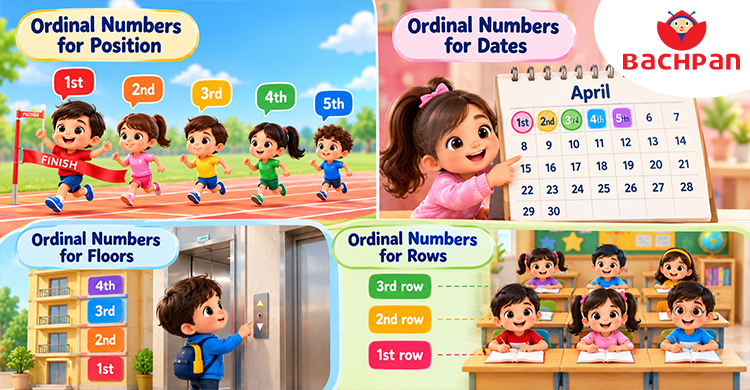
Ordinal numbers are used to express position in a particular sequence or rank. For example: ‘She came first in the race’, ‘He sat in the third row’ or ‘This is the fifth time I’m reading this book’. These examples show how ordinal numbers in English describe position rather than quantity. Parents can reinforce these concepts through counting games, sorting tasks, and other learning activities for preschoolers at home that make early maths more engaging.
Ordinal Numbers for Dates
Dates are generally expressed using ordinal numbers. “The 1st of January”, “her birthday is on the 21st of May” or “the meeting is on the 3rd of June”; they always seem to come in pairs.
Ordinal Numbers for Floors and Rows
Buildings and seats are examples of where ordinal numbers are used frequently. For instance, “Our classroom is on the second floor”, “I’m sitting in the fourth row”, or “The lift stops at the tenth floor”.
Ordinal Numbers Rules for Kids
Learning a few simple rules makes it much easier to know how to write ordinal numbers 1 to 100 correctly, without memorizing every single one by heart.
First, Second and Third
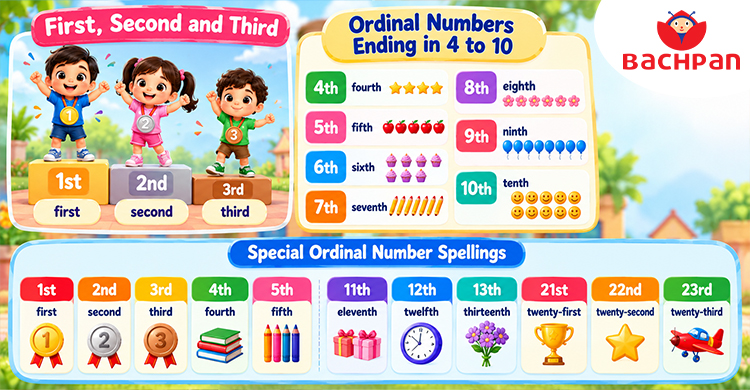
The form of the numbers 1, 2 and 3 is different: first, second and third, which are written as 1st, 2nd and 3rd, correspondingly. These exceptions should be memorized separately, since they do not follow the pattern of the rest of the numbers, which usually have the suffix – th.
Ordinal Numbers Ending in 4 to 10
From 4 to 10, ordinal numbers are formed by adding the suffix -th to the end of the cardinal number: fourth, fifth, sixth, seventh, eighth, ninth and tenth. The same rule is used for numbers from 11 onwards.
Special Ordinal Number Spellings
There are just a few numbers that alter their spelling more than you might expect when you add “-th” to the end, instead of just taking it on. Here are the ones you’re most likely to encounter.
| Cardinal | Ordinal |
|---|---|
| Five | Fifth |
| Nine | Ninth |
| Twelve | Twelfth |
| Twenty | Twentieth |
| Thirty | Thirtieth |
| Forty | Fortieth |
| Fifty | Fiftieth |
| Eighty | Eightieth |
Ordinal Numbers Practice for Kids
Practice is the best way to make these names stick. Try these simple exercises to test what you’ve learned with this ordinal numbers worksheet for kids-style practice. To make number practice more interactive, try these preschool activities parents can do at home and adapt suitable counting and sorting games to help children learn through play.
Write the Ordinal Number
Read each ordinal name and write its correct ordinal number form. Remember that ordinal numbers use suffixes such as st, nd, rd, and th to show position or order.
1. First = ______
2. Second = ______
3. Fifth = ______
4. Tenth = ______
5. Twelfth = ______
6. Twenty-First = ______
7. Thirty-Third = ______
8. Fiftieth = ______
9. Seventy-Second = ______
10. One Hundredth = ______
Answers: 1st, 2nd, 5th, 10th, 12th, 21st, 33rd, 50th, 72nd, 100th.
Write the Ordinal Name
In this exercise, convert each ordinal number into words. Pay attention to spelling, especially for numbers such as fifth, eighth, twelfth, and twentieth.
1. 1st = ______
2. 3rd = ______
3. 8th = ______
4. 12th = ______
5. 15th = ______
6. 20th = ______
7. 30th = ______
8. 45th = ______
9. 75th = ______
10. 100th = ______
Answers: First, Third, Eighth, Twelfth, Fifteenth, Twentieth, Thirtieth, Forty-Fifth, Seventy-Fifth, One Hundredth.
Choose the Correct Ordinal Number
Choose the correct option for each question. These multiple-choice exercises help children recognize ordinal numbers and understand how they represent positions in a sequence.
1. Which shows the fourth position?
A. 4
B. 4th
C. 40th
Answer: B. 4th
2. Which shows the twenty-first position?
A. 21
B. 12th
C. 21st
Answer: C. 21st
3. Which ordinal number comes after 9th?
A. 8th
B. 10th
C. 11th
Answer: B. 10th
4. Which is the correct ordinal form of 32?
A. 32nd
B. 32th
C. 32st
Answer: A. 32nd
5. Which ordinal number comes between 6th and 8th?
A. 5th
B. 7th
C. 9th
Answer: B. 7th
6. Which ordinal number represents the last position in a group of 50?
A. 50
B. 5th
C. 50th
Answer: C. 50th
7. Which is the correct ordinal form of 23?
A. 23th
B. 23rd
C. 23st
Answer: B. 23rd
8. Which ordinal number comes immediately before 100th?
A. 98th
B. 99th
C. 101st
Answer: B. 99th
Teachers and parents can make revision more enjoyable by using different types of preschool activities for kids, including games that encourage number recognition and sequencing.
Complete the Ordinal Number Sequence
Ordinal numbers help children understand the order of objects, people, and events. Fill in the missing ordinal numbers in each sequence to practise counting in the correct order.
1. 1st, 2nd, ______, 4th, 5th
2. 6th, 7th, ______, 9th, 10th
3. 11th, 12th, ______, 14th, 15th
4. 18th, 19th, ______, 21st, 22nd
5. 28th, 29th, ______, 31st, 32nd
6.47th, 48th, ______, 50th, 51st
7. 97th, 98th, ______, 100th
Answers: 3rd, 8th, 13th, 20th, 30th, 49th, 99th.
Identify the Position in Everyday Situations
Ordinal numbers are used in everyday life to describe positions and order. Read each situation and write the correct ordinal number to practise applying what you have learned.
1. Riya finishes a race in second place. Which ordinal number represents her position? ______
2. Aman is the first student in the queue. Which ordinal number describes his position? ______
3. A birthday cake has ten candles, and the tenth candle is lit last. Which ordinal number describes its position? ______
4. You finish reading the fifth page of a book. Write the ordinal number for that page. ______
5. A school competition has 25 participants. You finish in twenty-fifth place. Write the ordinal number. ______
6. Your classroom is on the third floor. Which ordinal number describes the floor? ______
7. You are celebrating your fiftieth birthday. Write the ordinal number for this birthday. ______
Answers: 2nd, 1st, 10th, 5th, 25th, 3rd, 50th.
Cardinal Numbers vs Ordinal Numbers
It is useful to look at cardinal and ordinal numbers together once more, but over a larger range, to be able to recognize the precise applications of one of these numbers. This comparison can help children revise cardinal and ordinal numbers and identify when each form is used.
| Cardinal Number | Ordinal Number | Use |
|---|---|---|
| 1 | 1st | Number/position |
| 2 | 2nd | Number/position |
| 3 | 3rd | Number/position |
| 4 | 4th | Number/position |
| 5 | 5th | Number/position |
| 10 | 10th | Number/position |
| 20 | 20th | Number/position |
| 100 | 100th | Number/position |
FAQs About Ordinal Numbers 1 to 100
Ordinal numbers show the position or order of something in a sequence, like first, second, or third, rather than how many of something there are.
They range from 1st (first) to 100th (one hundredth), with a number of regularly formed plurals based on the suffix – th, with few irregular forms, including fifth, ninth, twelfth, twentieth, etc.
The ordinal number of 1 is 1st, or “first.”
The ordinal number of 10 is 10th, or “tenth.”
The ordinal number of 20 is 20th, or “twentieth.”
The ordinal number of 50 is 50th, or “fiftieth.”
The ordinal number of 100 is 100th, or “one hundredth.”
Cardinal numbers represent quantity, like “five apples,” while ordinal numbers represent position or order, like “the fifth apple in line.” Both are essential, but they answer different questions.
Conclusion
Cardinal numbers are the numbers that describe quantity (e.g., five apples), while ordinal numbers are the numbers that describe position (e.g., the fifth apple). Though the two concepts are related, they are used in different contexts and, thus, serve different purposes. This Ordinal Numbers 1 to 100 for Kids guide, with an ordinal numbers chart, list, examples, and practice questions, provides a simple way to review the topic.