



Even and Odd Numbers: Easy Explanation for Kids
Learning numbers is one of the first steps in a child’s maths journey. As children become familiar with counting, they also begin to understand how numbers work. One interesting concept they learn is even and odd numbers. It helps them recognise number patterns, count objects, and understand how numbers can be grouped into pairs. Children can also strengthen their number recognition skills by practising these number names from 1 to 100 and learning to read numbers correctly. With simple examples, everyday objects, and fun activities, parents and teachers can make this concept easy to understand.
Let’s explore how children can learn to identify even and odd numbers through playful learning.
What Are Even and Odd Numbers?
Have you ever noticed how some objects form perfect pairs, while others leave one object without a partner? This simple observation helps children understand how numbers can be grouped into pairs. Even numbers divide evenly into two groups, while odd numbers leave one left over. Let’s explore them with simple examples.
What Are Even Numbers?
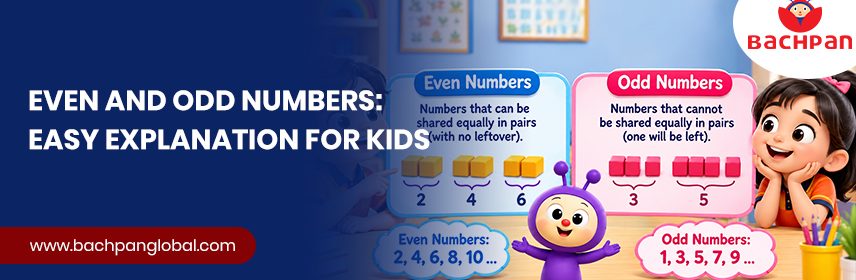
Even numbers can be split into two equal groups without leaving anything extra. This means every object gets a partner when arranged in pairs.
Numbers such as 2, 4, 6, 8, and 10 are examples of even numbers. Similarly, 12, 14, and 16 are also even because they can be divided equally into two groups. One easy way to recognise even numbers is that they always end in 0, 2, 4, 6, or 8.
What Are Odd Numbers?
Odd numbers cannot be divided into two equal groups without leaving one object behind. When we arrange them in pairs, one object always remains without a partner.
For example, 1, 3, 5, 7, and 9 are odd numbers. Numbers like 11, 13, and 15 are odd too. They always end in 1, 3, 5, 7, or 9.
Even and Odd Numbers from 1 to 100
Once children understand the basic idea, they can start recognising numbers by looking at their patterns. A simple number chart makes this easier and helps children practise number recognition.
The following chart shows both number groups from 1 to 100 separately. Children can use it for counting, skip counting, and identifying the numbers that belong to each group.
| Even Numbers | Odd Numbers |
|---|---|
| 2 | 1 |
| 4 | 3 |
| 6 | 5 |
| 8 | 7 |
| 10 | 9 |
| 12 | 11 |
| 14 | 13 |
| 16 | 15 |
| 18 | 17 |
| 20 | 19 |
| 22 | 21 |
| 24 | 23 |
| 26 | 25 |
| 28 | 27 |
| 30 | 29 |
| 32 | 31 |
| 34 | 33 |
| 36 | 35 |
| 38 | 37 |
| 40 | 39 |
| 42 | 41 |
| 44 | 43 |
| 46 | 45 |
| 48 | 47 |
| 50 | 49 |
| 52 | 51 |
| 54 | 53 |
| 56 | 55 |
| 58 | 57 |
| 60 | 59 |
| 62 | 61 |
| 64 | 63 |
| 66 | 65 |
| 68 | 67 |
| 70 | 69 |
| 72 | 71 |
| 74 | 73 |
| 76 | 75 |
| 78 | 77 |
| 80 | 79 |
| 82 | 81 |
| 84 | 83 |
| 86 | 85 |
| 88 | 87 |
| 90 | 89 |
| 92 | 91 |
| 94 | 93 |
| 96 | 95 |
| 98 | 97 |
| 100 | 99 |
Difference Between Even and Odd Numbers
Understanding the two types of numbers makes it easier for children to recognise number patterns and solve basic maths problems. The following table highlights their key differences through simple rules, number endings, grouping, and easy-to-understand examples of even and odd numbers for kids.
| No. | Even Numbers | Odd Numbers |
|---|---|---|
| 1 | Can be divided into two equal groups without a remainder. | Cannot be divided into two equal groups without a remainder. |
| 2 | End in 0, 2, 4, 6 or 8. | Ends in 1, 3, 5, 7 or 9. |
| 3 | Can be arranged in pairs with no object left over. | One object remains without a partner when arranged in pairs. |
| 4 | Examples: 2, 4, 6, 8, 10. | Examples: 1, 3, 5, 7, 9. |
| 5 | Zero is an even number. | One is an odd number. |
Easy Rules to Identify Even and Odd Numbers
Children do not need to count every object to identify a number. A few simple tricks can help them recognise number patterns and understand the even and odd number rules. Here are some easy methods parents and teachers can use.
Check the Last Digit
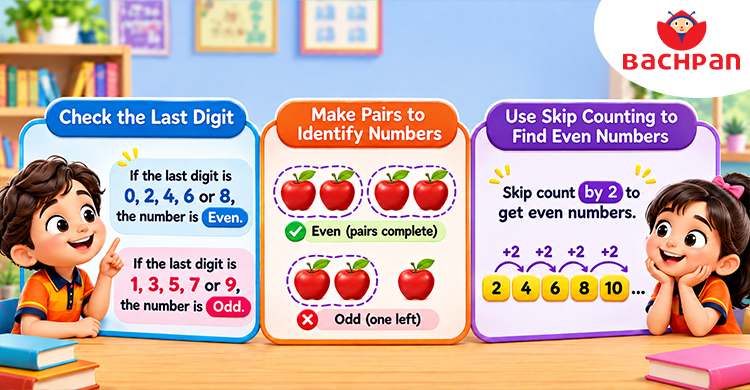
Want a quick shortcut for spotting even and odd numbers? Just check the last digit. Any number ending in 0, 2, 4, 6, or 8 is an even number, whereas numbers ending in 1, 3, 5, 7, or 9 are odd numbers. No matter how big or small a number gets, this trick makes it super easy to tell them apart.
Make Pairs to Identify Numbers
Grouping objects into pairs is an easy way to teach even and odd numbers to young kids. Ask your child to match blocks or crayons in twos. If every item gets a buddy, it is an even number. If one stays alone, it is an odd number.
Use Skip Counting to Find Even Numbers
Skip counting is an easy way for children to recognise even numbers for kids. Encourage them to count forward by adding two each time: 2, 4, 6, 8, 10, 12, and so on.
This helps children understand that even numbers come in a pattern, with every second number being even. They can also practise counting odd numbers by starting at 1 and adding two each time: 1, 3, 5, 7, 9, and so on.
Once children become comfortable with skip counting, they can explore other number patterns through the 8 times table in maths for kids and practise recognising multiples.
Fun Activities to Teach Even and Odd Numbers
Children understand new concepts better when they can see, touch, and experience them. Instead of only practising numbers on paper, parents and teachers can introduce simple games that make maths enjoyable. Here are some fun activities to teach even and odd numbers.
Parents can explore more fun maths activities for kids to help children practise counting, number recognition, and basic maths concepts through play.
Pair the Objects
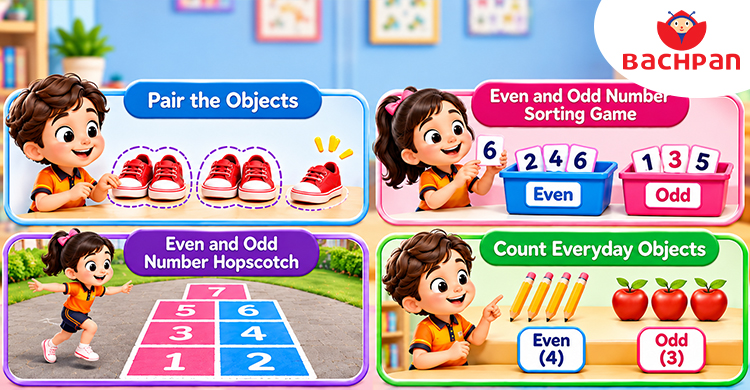
Gather a few clean socks, shoes, or bangles from around the house and ask your child to group them into pairs. This simple activity helps children understand odd numbers for kids through everyday objects. When one object is left without a partner, it shows an odd number. For example, 3 socks make one pair with 1 sock left over.
Even and Odd Number Sorting Game
Write numbers from 1 to 20 on colourful paper chits and place two bowls on the table. Label one bowl even numbers and the other odd numbers. Let your child pick a chit and drop it into the matching bowl for fun number recognition.
Even and Odd Number Hopscotch
Draw a long number line or hopscotch grid with chalk on the floor. Call out either even numbers or odd numbers, and encourage your child to jump only on those tiles. Active play strengthens even and odd number rules while keeping kids energetic and smiling.
Count Everyday Objects
Turn snack time or evening walks into fun maths for kids by counting everyday items like grapes, spoons, buttons, or steps. Ask your little one whether the total count is an even or odd number. Daily practice builds strong early maths skills naturally without any pressure.
Even and Odd Numbers Worksheet for Kids
Now it is time for some cheerful practice. Use this even and odd numbers worksheet for kids to revise and check how confidently they can solve each question on their own.
| No. | Question | Answer |
|---|---|---|
| 1 | Is 8 an even or odd number? | Even |
| 2 | Is 13 an even or odd number? | Odd |
| 3 | Is 20 an even or odd number? | Even |
| 4 | Is 17 an even or odd number? | Odd |
| 5 | What is the next even number after 10? | 12 |
| 6 | What is the next odd number after 15? | 17 |
| 7 | Which number is odd: 24, 31 or 46? | 31 |
| 8 | Which number is even: 19, 27 or 32? | 32 |
| 9 | Is zero an even or odd number? | Even |
| 10 | Is 99 an even or odd number? | Odd |
Even and Odd Numbers Quiz for Kids
Ready for a little number challenge? This quick quiz on even and odd numbers in maths will help children practise identifying even and odd numbers, recognise number patterns, and test what they have learned. Read each question carefully and choose the correct answer!
FAQs About Even and Odd Numbers
Even numbers are whole numbers that can be divided by two into two equal groups with zero remainder. When arranged in pairs, no object is left alone. They always end in 0, 2, 4, 6, or 8, such as 2, 4, 6, 8, and 12.
Odd numbers are whole numbers that cannot be split into two equal groups. When you group Odd numbers for kids into pairs, one item is always left over. They end in 1, 3, 5, 7, or 9, such as 1, 3, 5, 7, and 11.
The easiest trick for identifying even and odd numbers is checking the digit in the ones place. If a number ends in 0, 2, 4, 6, or 8, it is even. If it ends in 1, 3, 5, 7, or 9, it is odd.
Zero is an even number because it can be divided by two without leaving a remainder. It is also the first number in the sequence of non-negative even numbers.
1 is an odd number. If you have just one apple or one toy, you cannot make a pair of two, which leaves that single object without a partner.
Yes! Any whole number, whether small or large, is either even or odd. Children can identify larger numbers by checking their last digit. For example, 246 is even because it ends in 6, while 357 is odd because it ends in 7.
Conclusion: Make Learning Even and Odd Numbers Easy for Kids
Learning maths becomes easier when children can connect numbers with everyday experiences. From making pairs to playing sorting games, simple activities can help them understand number patterns and build confidence. Parents and teachers can use these playful methods to make even and odd numbers easier to recognise and remember. With regular practice, children gradually develop number recognition, logical thinking, and early maths skills. The idea is to keep learning enjoyable, encourage curiosity, and let little learners discover the joy of numbers at their own pace.