


Maths Activities for Kids: Fun Ways to Learn Numbers and Counting
For studying maths, we don’t need a worksheet every time. Sometimes small, playful steps can help in building a strong number sense. Young kids learn numbers best when they can find them relatable in their lives as well. This blog shares fun maths activities for kids to learn math at home. Readers will also get age-appropriate ideas, practice tips, and a quick practice checklist. These maths activities for kids are suitable for preschoolers, and many work for nursery and kindergarten-going little learners too. You can also help children practise number recognition with these number names from 1 to 100 as they become familiar with counting. Here’s more to go. So, let’s begin.
Why Are Maths Activities Important for Kids?
Early maths should be enjoyable for a kid; otherwise, it becomes a burden. In particular, we should focus more on play-based learning. That’s why early maths activities for preschoolers work best as enjoyable games. Good maths learning activities for kids feel like play. And they will never feel the pressure of learning something very difficult to study later.
10 Fun Maths Activities for Kids
We are providing ten hands-on maths activities for kids. These number activities for kids will help them learn counting, number recognition, and early addition and subtraction. So, here we go.
1. Number Recognition and Matching
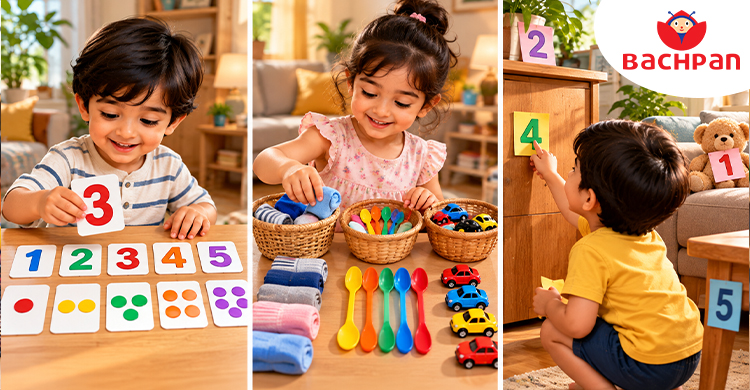
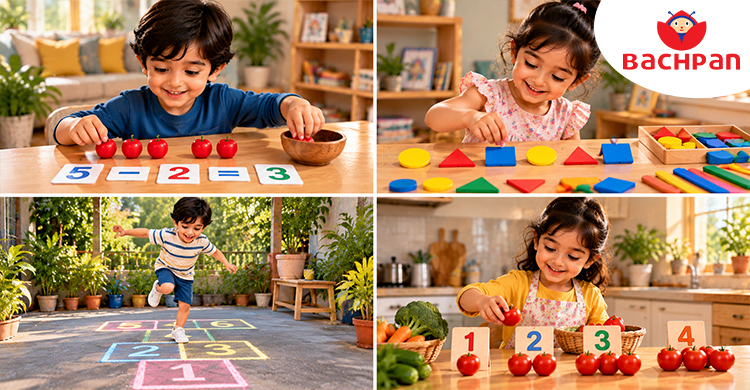
This is one of the best and easiest number recognition activities for kids at home. Write some numbers and draw addition and subtraction symbols on cards. Now give the kids some challenges by placing a symbol card between two number cards to see what result they will say. Such number recognition activities for kids at home need only paper and a pen, nothing more. A ready-made kit can save prep time. The Bachpan Box Math Quest Kit is one of the best options for maths activities for kids.
2. Count and Sort Household Objects
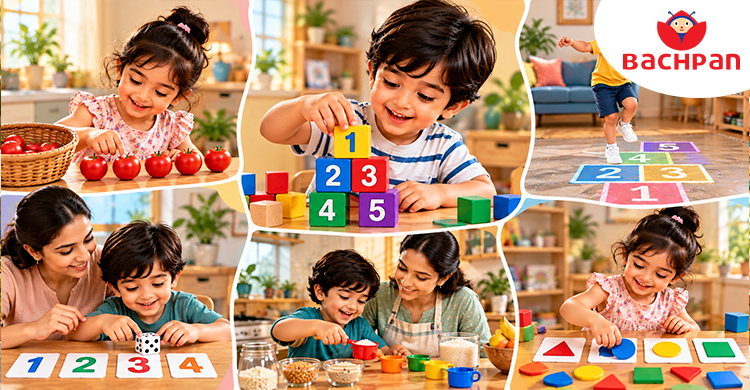
Counting activities for kids work best when the kids relate them to their real lives. Gather some daily-use objects like spoons, buttons, or socks. Ask the child to count each group aloud. Then sort those items by color and size. Make sure the toddler touches each item once while counting, as it builds one-to-one matching. Counting real and visible objects with parents boosts toddlers’ number recognition knowledge.
3. Number Hunt Around the House
Turn your home into a number treasure map with this number activity for kids. Ask the child to find numbers visible on a clock, a calendar, a book page, or the home address plate. Call out a number and let the child hunt for it. Number cards could also work better if hidden properly around the room. Just remember to give a small cheer for each find. This builds number recognition in real life.
4. Counting with Blocks and Toys
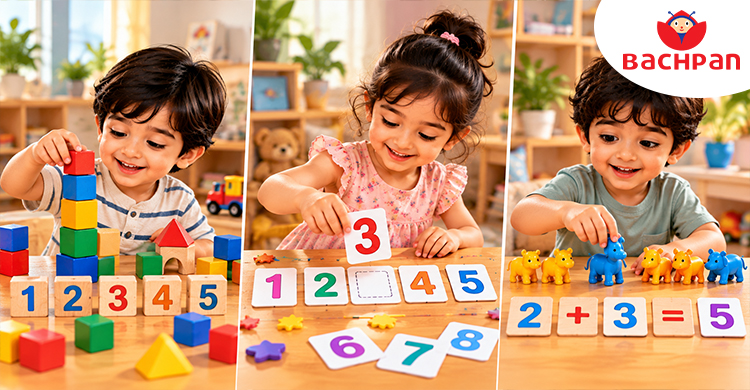
Block counting turns a normal activity into a counting activity for kids. Build a tower of blocks, and counting each block is a good activity to follow. Or, line up some toy cars and count them. These hands-on maths activities for preschoolers also help in developing fine motor skills. Interact with kids by asking, “Can you add one more brick? How many are there now?” Just remember to keep tiny pieces away from toddlers under three.
Activities involving blocks, toys, and small objects can also strengthen hand control. Explore these fine motor activities for preschoolers for more playful ways to develop these skills.
5. Missing Number Game
This game is one of the simple maths games for kids to learn numbers in the right order. Place some number cards in a row. Ask the child to look away. Remove one card. Then the child has to look back and find out the missing number. Sometimes the roles can be swapped too. Like, the child can hide a card from their parent. It will help them to know the number sequence better. This game will also teach the child to think about what comes before and after.
6. Simple Addition with Objects
Addition becomes super simple when the child can see and sense it. Place two buttons in a cup and three in another. Then ask the child to count the total buttons there. So, addition and subtraction activities for preschoolers can be started initially with small numbers. Just remember to celebrate every correct answer with a high five.
7. Take-Away Subtraction Game
Subtraction is just taking away something. Start with some small toys on the table. Ask the child to count them. Then hide some of them. Ask them how many are left. It is one of the easiest-to-follow educational maths games for kids to play at home. It can be done using short stories too. Like, five birds sit on a branch. Two fly away. How many remain? So all such activities will work in real life.
8. Shape and Pattern Activities
Shapes and patterns related activities are one of the key maths learning activities for kids. Give your child colored blocks or shape cards. Place them in a pattern like red, blue, red, blue. Then ask the child to continue it and ask what comes next. Hunt for the shapes around your home too. For example, a plate is a circle. A window is a rectangle. So the child will learn addition, skip counting, and problem solving through these activities.
To help children recognise more geometric shapes, parents can explore these shape names for kids with pictures and examples and introduce them through familiar objects and everyday examples.
9. Number Hopscotch and Movement Games
Movement helps in remembering the numbers for a long time. Draw a hopscotch grid with chalk. Write numbers 1 to 10 in the boxes. Ask the child to hop on each number and say it aloud. These are great counting games for 3 to 5-year-olds. Let them hop forward and then backward to practice counting back. Cheer each hop, and keep each round short.
10. Everyday Counting in the Kitchen
The kitchen is usually full of maths. Ask the child to count spoons for dinner. Let the child pour two cups of water into a jug. Count the veggies and more. Everyday counting makes maths activities for kids at home feel natural. Usually, toddlers who hear more numbers at home later understand numbers better. Just keep the activities light and let the child engage.
Maths Activities for Kids by Age Group
Every child has different attention spans, and they learn at different paces. Go through the following table. It suggests maths activities for nursery and kindergarten kids, along with some relatable maths activities for preschoolers.
| Age Group | Suggested Activities | Learning Focus |
|---|---|---|
| 2–3 years | Counting toys, number songs, sorting objects | Early counting and quantity awareness |
| 3–4 years | Number matching, counting games, shape sorting | Number recognition and basic patterns |
| 4–5 years | Missing numbers, simple addition, number sequences | Counting accuracy and early arithmetic |
| 5–6 years | Addition and subtraction games, simple word problems | Applying early maths concepts |
How to Make Maths Learning Fun at Home
For teaching maths to kids, fancy tools don’t always work. Children need time, patience, and, most importantly, a playful mood. Five tips are given to show how to teach numbers and counting through play.
Apart from maths games, parents can explore more preschool activities they can do at home to make everyday learning enjoyable.
Use Everyday Objects for Counting
Let the child count whatever they find around them. Stairs, shoes, toys, fruit, and so on. Work on the number’s identification and pronunciation. If the child touches and counts each object, they tie the numbers to real amounts. This is known as the cardinal principle. Children usually master it after the other counting rules.
Practise Through Short Games
Ten minutes of maths games for kids works better than an hour of pressure. Short play sessions help keep interest high. They also make maths feel relatable and easy. Gamified learning also removes the fear of getting a wrong answer. Repeat the same game for a few days. Repetition builds confidence. Just keep the mood warm.
Parents can also explore these hands-on learning activities for preschoolers at home for more practical ways to make learning enjoyable through play.
Connect Numbers to Real-Life Situations
Numbers are everywhere around us. Encourage the child to count the steps as they walk, read the price tags of shopping products, check the time on the clock, talk about age, floors, phone numbers, and so on. Real-life use gives maths a purpose beyond academics when the child starts to see maths as useful, not just some random schoolwork.
Encourage Children to Try Again
We learn from our mistakes. If the child counts wrong, stay calm. Say, “Let’s count together once more.” Appreciate the effort, not just the correct answer. Avoid saying “no” or “wrong” immediately. A relaxed child tries to do more. A worried child stops trying. Every positive moment built will develop a positive attitude in the child.
Match Activities to Your Child’s Learning Level
Observe what your child can do easily. Like, if counting to ten is easy, move to twenty. If twenty feels hard, stay on ten. Refer to the age table given above as a guide. Ask a few questions to check understanding. Adjust the activity based on the answers. Hands-on maths activities for kids work best at the right level.
How Educational Maths Kits Can Support Learning
Some parents prefer ready-made help. Educational activity kits for kids have good materials, and that too in a box. It saves prep time and also keeps practice tidy and consistent. Think of an educational kit as a helpful tool, not a teacher. A parent’s role stays central.
Parents can also explore these learning activities for preschoolers at home for more ideas that encourage hands-on learning.
What to Look for in a Maths Learning Kit
Not every kit is appropriate for the child. Look out for the one that matches the level of the child’s age. The NCERT’s Jaadui Pitara, launched under NEP 2020 for ages 3 to 8, is also a box of play-based learning materials. Use whatever, but don’t forget to check these four things before buying anything. A kit that is not interesting will gather dust. A good kit gets used every week.
- Age-appropriate activities
- Opportunities to handle, match, sort, and count
- Clear instructions for parents
- Safe, durable materials
Explore the Bachpan Box Math Quest Kit
The Bachpan Box Math Quest Kit is an educational maths kit made for young learners. It is for early number practice, including addition and subtraction. It is best for maths activities for kids using educational kits referred to in this blog, such as counting and simple sums. This learning kit is for toddlers aged 3+. This kit includes a Math Quest Learning Board, Colorful Pom Poms, Practice Sheets, and Addition and Subtraction Equation Tiles. Watch the demonstration video to see the kit in action: Math Quest Demo Video.
Maths Activities for Kids: Quick Practice Checklist
Refer to this table for a quick plan. Just pick an activity, gather the materials, and then start. It shows what you need and what your child learns. Small steps will add up over weeks; just stay consistent.
| Maths Activity | Materials Needed | What Kids Learn |
|---|---|---|
| Number Recognition and Matching | Number cards or number chart | Number identification |
| Count and Sort Objects | Blocks, toys, or safe household objects | Counting and sorting |
| Number Hunt | Books, calendars, or number cards | Recognising numbers in everyday life |
| Counting with Blocks | Building blocks or counting objects | Counting and quantity recognition |
| Missing Number Game | Paper and pencil or number cards | Number sequencing |
| Simple Addition | Blocks, counters, or toys | Combining quantities |
| Take-Away Subtraction | Small groups of counting objects | Understanding subtraction |
| Shape and Pattern Activities | Shape cards, blocks, or coloured objects | Shape recognition and pattern identification |
| Number Hopscotch | Number cards or floor markers | Number recognition and movement |
| Everyday Counting | Fruits, cups, or spoons | Applying maths to daily activities |
FAQs About Maths Activities for Kids
There can be multiple fun maths activities for kids, which include number hunts, counting blocks, missing number games, hopscotch, and kitchenware counting. These activities need few items and little time. Start with one activity a day. Keep that activity playful, and stop before the child tires.
Start by counting the real objects together every day. Let the kid touch each item once and say the number aloud. You can also begin with groups of objects.
You can use number cards, calendars, clocks, and books. Play matching and number hunt games. Ask your child to point to a number you call out. Trace the numbers on paper for extra practice. Repeat often and stay patient.
Activities like counting toys, sorting objects, number matching, shape sorting, and simple patterns are suitable for preschoolers.
You can use toys, blocks, or any countable objects. For example, join two small groups and count all. For subtraction, hide a few items and count those that are left. Practice a few minutes every day. These addition and subtraction activities for preschoolers help kids to understand the basics of calculation through real-world examples.
Absolutely yes. But only when used well. A good educational kit saves prep time and provides hands-on practice with matching, sorting, and counting. It works best when played along. Choose an age-appropriate kit with clear instructions and safe materials. A kit supports learning, and everyday talk about numbers matters too.
Conclusion
Young learners can learn maths while enjoying it. A spoon, a block, or a hopscotch grid is enough to start. Pick a few maths activities for kids from this blog. Repeat them often, and keep each learning session short. Match the activity to the child’s growth level and don’t forget to celebrate every win. Add an educational kit if extra structure is needed. Most of all, talk about numbers with the kids every day. Start today with one simple activity. Count the spoons at dinner, and see where it leads.