



Parts of a Flower: Nature’s Hidden Wonders for Kids
Imagine a flower as a vibrant surprise box with little treasures inside. Parts of a flower and their functions for kids help them discover what makes a flower grow, bloom, and stay beautiful.
Every part of a flower serves a specific purpose, such as protecting it, producing seeds, or attracting insects. A flower remains healthy and vibrant when these components cooperate.
Ready to open the flower and explore what’s inside? Let’s begin!
What Are the Parts of a Flower?
Before we dive deeper, let’s first understand the parts of a flower and see how each part works together to help a flower grow, bloom, and reproduce beautifully.
Why Flowers Are Important for Plants
Ever ponder why flowers are more than simply pretty? Flowers aid in seed production, attract pollinators, and promote the growth of new plants.
Without flowers, plants couldn’t reproduce, and nature’s wonderful cycle of life wouldn’t continue. They keep our world green and blooming!
Simple nature lessons highlight the importance of early education in building curiosity and thinking skills.
Main Parts of a Flower and Their Functions
Let’s learn about flower parts and functions — each part has a special job, from protecting the flower to attracting insects and helping make seeds for new plants.
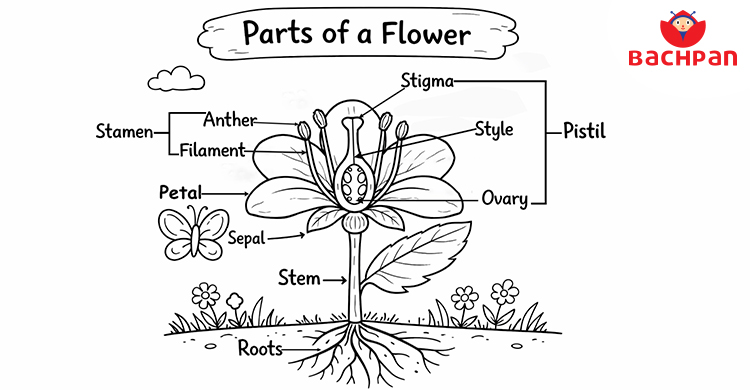
Sepals – The Protective Part of a Flower
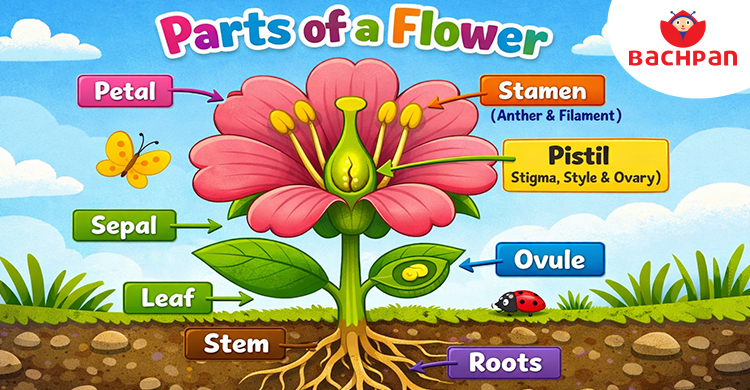
One of the main parts of a flower is the sepals. Think of them as a little green jacket wrapped around the flower bud.
Just like a jacket keeps you safe from rain, cold, or wind, sepals protect the delicate bud before it blooms and continue to support the petals, keeping the flower strong and healthy.
Petals – The Colourful Part That Attracts Insects
Petals are the bright, colourful parts of a flower. Imagine them as a flower’s colourful cloth.
- Bright and vivid, they attract bees, butterflies, and other insects
- They direct insects to the centre of the flower
- For new plants to grow, this aids the flower in producing seeds
Stamen – The Male Part of a Flower
One of the main parts of a flower is the stamen, the male part. Think of it as the flower’s pollen factory.
- It produces pollen, which are tiny particles
- The female portion of a flower must receive pollen
- This helps the flower make seeds and grow new plants
Anther – Where Pollen is Made
Ever wondered where a flower keeps its tiny yellow “dust” for making seeds? That’s the anther!
You can think of it as the flower’s pollen basket. Bees, insects, and even the wind come by to gather this pollen and deliver it to the female side, helping flowers to create new baby plants.
Filament – Holds the Anther in Place
Have you noticed how the anther doesn’t fall off the flower? That’s the filament’s duty!
Imagine it as a little flower stick that holds the pollen basket (anther) straight. By maintaining the anther in place, the filament makes sure pollen can reach the female portion, helping the flower create seeds and grow new flowers.
Female Parts of a Flower and Their Functions
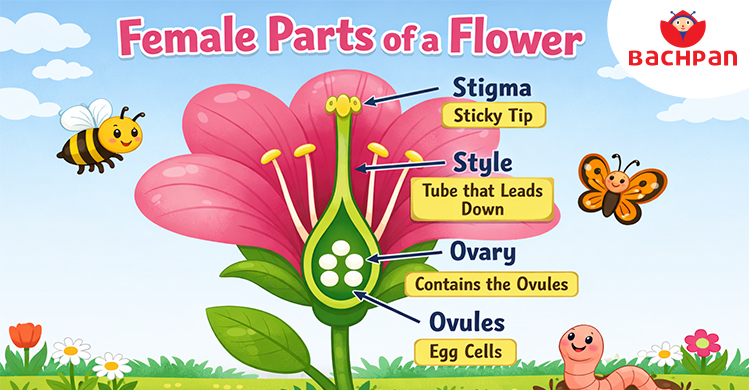
The parts of a flower and their functions for kids show how the female parts help in making seeds, receiving pollen, and supporting the growth of new plants.
Pistil – The Female Part of a Flower
Looking at the parts of a flower diagram, you’ll see the pistil, the female part of the flower. Think of it as the flower’s seed maker.
- It waits to receive pollen from the male part
- Once pollen arrives, the pistil helps form seeds inside the flower
- These seeds can grow into new flowers, continuing the life of the plant
Stigma – Receives Pollen
Ever wondered how a flower catches pollen? The stigma is like the flower’s tiny catching pad.
- It waits for pollen to arrive from the male part
- When pollen lands, the stigma holds it safely inside the flower
- This helps the flower make seeds, which can grow into new flowers
Style – Connects Stigma to the Ovary
Did you know a flower has its own tiny bridge? That’s the style!
- It connects the sticky part on top (stigma) to the base (ovary)
- Pollen slides down this bridge to reach the ovary safely
- Think of it like a pathway that helps pollen travel safely from the top of the flower to the base
Ovary – Produces Seeds
Have you noticed the round part at the base of a flower? That’s the ovary.
- It stores the seeds as they begin to grow
- It keeps them protected until they are ready
- It also decides how many seeds the flower can make
How Flower Parts Work Together
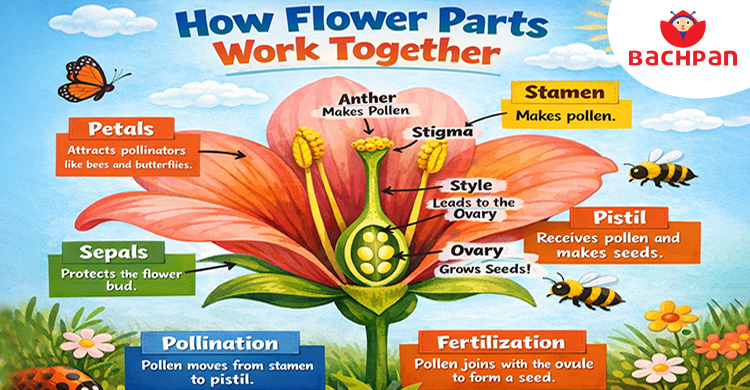
The function of flower parts explains how each part works together, supporting the flower, helping pollination, and enabling seed formation so new plants can grow successfully.
Pollination – How Flowers Make Seeds
Have you ever wondered how flowers produce seeds? Ask your child: “Who do you think helps flowers make babies?”
Pollination is the process by which tiny bees and butterflies transfer pollen from one flower to another. When pollen reaches the correct area, seeds start to grow. Watch together as flowers turn into new life!
Fertilisation and Seed Formation
Fertilisation is like a tiny handshake — pollen meets the ovule, and seeds start to form. Each seed is packed with the potential to grow into a new plant.
From a tiny dot to a big, blooming flower, nature’s magic shows how life begins in the smallest places!
Role of Insects, Wind, and Water
Who helps flowers make seeds?
Tiny insects like bees and butterflies carry pollen from one flower to another. Wind blows it around, and water can float it to new places. Without these helpers, plants can’t grow.
These helpers make sure seeds form so new plants can thrive, keeping our gardens, farms, and forests full of life!
Other Important Parts of a Flower
Apart from the main parts of a flower, other features help protect the flower, attract pollinators, and support seed formation and plant growth.
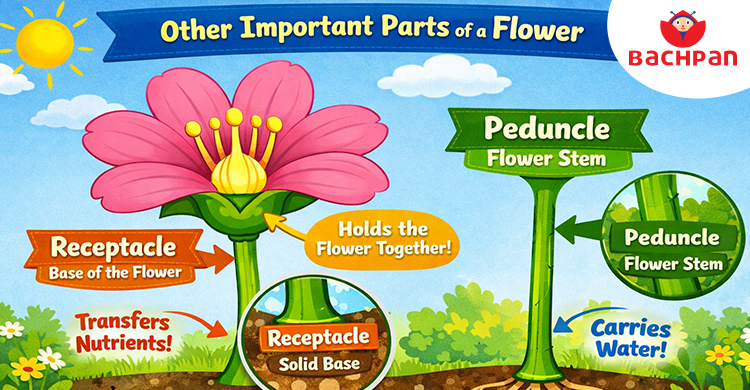
Receptacle – The Base of the Flower
See the bottom of the flower? That part is the receptacle.
It holds all parts together while growing. It joins petals to the stem, in addition to conveying food. Think of it as a solid base; it keeps the flower steady, healthy, and supported
Peduncle – The Flower Stem
Look at the flower’s stem, it’s called the peduncle!
Can you see how it holds the flower up straight? This stem helps the flower face the sunlight and welcome pollinators.
It also takes water and nutrients from the plant, so the flower can develop, blossom, and stay healthy while making seeds.
Parts of a Flower Diagram for Kids
Parts of a flower for kids diagram helps children clearly see where each part is placed, making it easier to understand the flower’s structure and how all parts fit together.
How to Identify Flower Parts Easily
To identify the parts of a flower easily, start by looking at its shape, colour, and centre. Examine each area in detail, carefully divide the parts if you can, and compare them with a simple diagram.
For example, take a sunflower — its petals, stem, and centre are easy to spot and match perfectly with a labelled diagram!
Fun Ways to Teach Parts of a Flower to Kids
Parts of a flower and their functions for kids can be taught in fun and engaging ways that make learning exciting, memorable, and easy to understand.
Flower Parts Activity for Kindergarten Kids
Kindergarteners can explore and recognise various flower parts with the help of a flower parts activity. Children might, for instance, match vibrant paper cutouts to an actual flower, putting each part in its proper place.
This hands-on activity makes learning interesting, interactive, and helps kids remember the names and functions of each part.
Children remember concepts better through learning through activities rather than memorising names.
Flower Crafts and Colouring Activities
Kids may enjoy learning about flowers with floral crafts and colouring activities. For instance, kids can use coloured sheets to create a paper flower or colour a printed floral diagram.
These exercises foster creativity, fine motor skills, a love of the natural world, and the ability to identify and comprehend the various parts of flowers.
You can pair these flower crafts with other art and craft activities for kids to make learning more creative.
Why Learning Parts of a Flower Is Important for Children
Learning parts of a flower and their functions for kids is important because it builds curiosity, observation skills, and a basic understanding of plants and nature.
Helps Build Early Science Knowledge
Learning about flower parts and functions helps build early science knowledge in children.
Children begin to notice details, ask questions, and have a greater understanding of plants as they explore the parts of a flower and observe how they function.
It resembles the beginning of biology! They learn about plant life, growth, and why nature matters, making future science study exciting and engaging!
Improves Observation and Thinking Skills
Learning about flowers is like being a nature detective! Children examine petals, stems, and centres, identifying tiny details and learning how everything functions. It’s similar to figuring out a plant puzzle!
This hands-on fun improves observation and problem-solving skills, making kids into little scientists who notice even the slightest things around them.
Just like nature lessons, teaching kids about culture and traditions helps build values and awareness.
Conclusion: Parts of a Flower and Their Functions Made Easy
Learning parts of a flower and their functions for kids can be super fun and exciting!
Imagine discovering the tiny jobs each part of a flower does: some protect, some help make seeds, and some attract buzzing bees. With colourful diagrams, playful activities, and hands-on exploration, kids can see, touch, and remember everything easily.
It’s like going on a little adventure inside a flower while building curiosity, creativity, and a love for nature! To learn more, visit us at www.bachpanglobal.com
FAQs on Parts of a Flower for Kids
A1: The main parts of a flower are the sepals, petals, stamens (male part), and pistil (female part).
A2: Petals help attract insects and birds to the flower, which helps in pollination.
A3: The ovary is the part of the flower that makes seeds.
A4: Kids should learn about flower parts to understand how plants grow, make seeds, and live in nature.