


States of Matter for Kids: Solids, Liquids & Gases
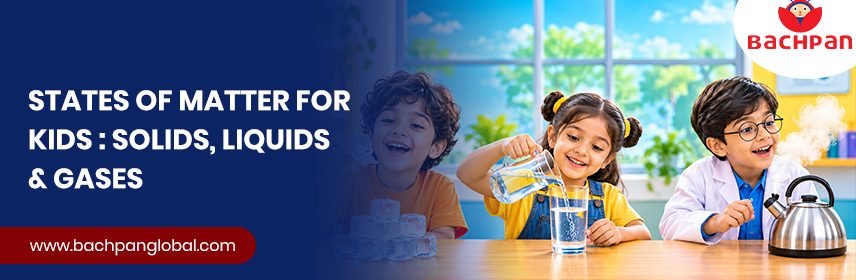
Look around your home. A book, a glass of water, and the air inside a balloon may seem very different. However, they are all made of matter. Matter exists in different forms, and these three states of matter are solids, liquids, and gases. Learning about these forms helps children understand the world around them. From melting ice to boiling water, everyday experiences offer simple ways to explore states of matter in science. In this blog, we will explain the states of matter for kids in a very simple way.
What Is Matter?
Almost everything around us is made of matter. Chairs, food, and water are common examples. Matter consists of tiny particles that are always moving. These are the basic ideas behind matter and its properties. Their arrangement, spacing, and movement vary across the different states of matter, giving solids, liquids, and gases unique properties. This makes the states of matter explained for kids easier to understand.
What Are the Three States of Matter?
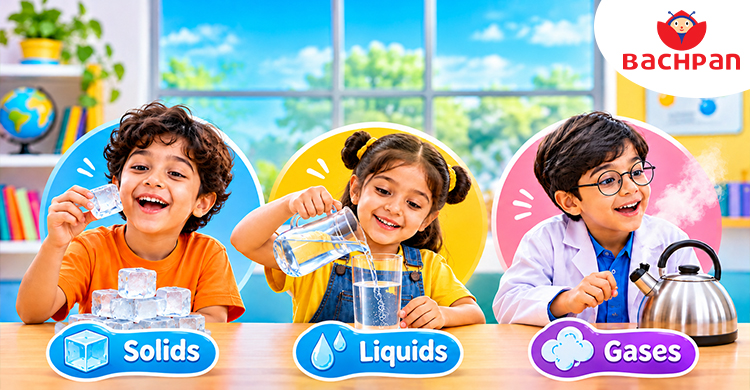
What are the three states of matter? The three states of matter are solid, liquid, and gas. Each has unique properties. This States of Matter for Kids blog explains their differences through simple examples.
1. Solids
In solids, particles are tightly packed and held in fixed positions. They can vibrate, but cannot move freely from one place to another. This gives solids a definite shape and volume. A book, stone, ice cube, and wooden table are common examples of solids for kids. Each demonstrates how solids maintain their shape unless an external force changes it.
2. Liquids
It takes the shape of the container in which we pour it. Its particles stay close together but can move around each other. This allows liquids to flow easily. Water, milk, juice, and cooking oil are familiar examples. We can pour them from one glass or bottle into another without changing their volume.
3. Gases
In gases, particles are far apart and move freely in all directions. This allows gases to spread out and fill the available space. Although we cannot usually see them, we can observe their effects. For example, when air enters a balloon, it spreads inside and makes the balloon expand. This shows how gases occupy space without having a fixed shape or volume.
Difference Between Solids, Liquids and Gases
The difference between solids, liquids, and gases lies in their shape, volume, and particle arrangement. These properties of matter help explain how each state behaves.
| Property | Solids | Liquids | Gases |
|---|---|---|---|
| Shape | Fixed shape | Take the shape of the container | No fixed shape |
| Volume | Fixed volume | Fixed volume | No fixed volume |
| Ability to Flow | Does not flow | Can flow | Can flow and spread |
| Particle Arrangement | Closely packed | Close together but can move around | Far apart |
| Examples | Book, ice, stone | Water, milk, juice | Air, oxygen, helium |
This table compares the properties of solids, liquids, and gases. Solids keep their shape, liquids flow, and gases fill available space.
How Does Matter Change from One State to Another?
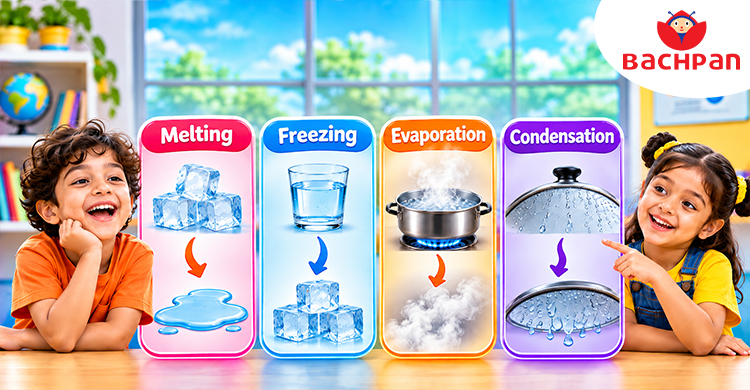
Matter changes from one state to another when it gains or loses heat energy. Heating and cooling affect particle movement. For example, ice melts into water when heated, while water freezes when cooled. These examples help children understand how matter changes from one state to another.
Water also changes its form as part of a natural process. Children can explore this further through this simple explanation of the water cycle for kids, including evaporation and condensation.
Melting
When we leave an ice cube outside the freezer, it gradually melts into liquid water. This happens because its particles gain heat energy and move more freely. The solid changes into a liquid. Different solids melt at different temperatures, depending on the material and its properties.
Freezing
When we place water in a freezer, it gradually turns into ice. As the water cools, its particles lose energy and move less freely. They arrange themselves into a fixed structure, forming a solid. This change from liquid to solid is called freezing.
Evaporation
During evaporation, water particles gain heat energy and escape into the air as water vapour. For example, wet clothes dry as water evaporates, even without boiling. Sunlight provides heat, while moving air carries away water vapour. Both conditions can speed up evaporation and help clothes dry faster.
Condensation
For example, tiny water droplets appear on the outside of a cold glass on a warm day. Water vapour in the surrounding air cools near the glass and forms droplets. This process also helps form clouds in the atmosphere. It is the opposite of evaporation.
Everyday Examples of States of Matter
Examples of solids, liquids, and gases can be found everywhere. These everyday examples of states of matter make science easier to understand. Common states of matter examples include a wooden table, milk, and air.
| No. | Object or Substance | State of Matter |
|---|---|---|
| 1 | Ice cube | Solid |
| 2 | Water | Liquid |
| 3 | Air | Gas |
| 4 | Milk | Liquid |
| 5 | Stone | Solid |
| 6 | Steam | Gas |
| 7 | Juice | Liquid |
| 8 | Wooden table | Solid |
| 9 | Oxygen | Gas |
| 10 | Cooking oil | Liquid |
These solid, liquid, and gas examples show how matter exists around us.
Fun Activities to Teach States of Matter to Kids
Children learn science better through hands-on exploration. Simple experiments make learning exciting and memorable. These states of matter activities for preschoolers use common household objects. Try these fun experiments to teach states of matter and help young learners understand science through observation, interaction, and play.
Children understand science concepts more easily when they can observe, experiment, and explore. Parents can discover more hands-on learning activities for preschoolers at home to make everyday learning interactive and enjoyable.
Sort Objects into Three States
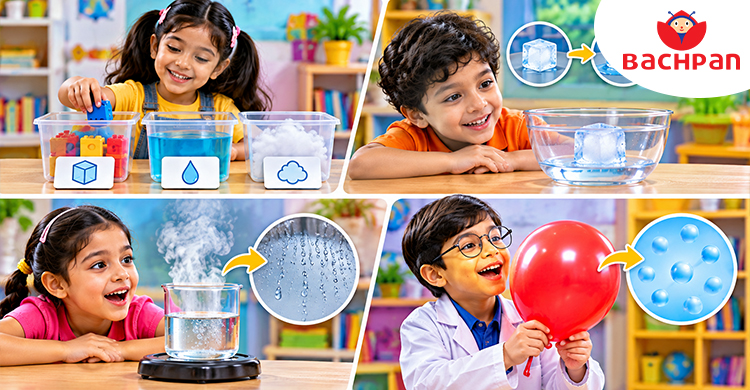
Collect a few safe household objects, such as a toy, spoon, water bottle, and glass of water. Ask children to group them as solids, liquids, or gases. They can also draw pictures of each group. Discuss why each object belongs to that category. This simple sorting activity helps children recognise different states of matter.
Watch an Ice Cube Melt
Place an ice cube on a plate and ask children to observe it. Let them notice how it slowly changes from a solid into liquid water. Ask what caused the change and where the water came from. They can draw the ice cube at different stages. This activity introduces melting through a familiar experience.
Observe Water Evaporation
Mark the water level and check it after a few hours or the next day. Children will notice that the water level decreases. Explain that some water changes into invisible water vapour and mixes with the air. This is evaporation.
Explore Air with a Balloon
Give children an uninflated balloon and ask them to observe its shape. With adult supervision, inflate it and let them notice how it expands. Explain that air is a gas that spreads out and fills the available space inside the balloon. This activity makes an invisible substance easier to understand through observation.
States of Matter Worksheet for Kids
Help children revise the three states of matter with this simple states of matter worksheet for kids. These questions cover solids, liquids, gases, their properties, everyday examples, and changes of state. After completing the worksheet, children can test what they have learned with a short quiz. Ask them to identify different substances, compare their properties, and name changes of state. Parents and teachers can use simple oral questions or picture-based prompts. This makes revision more engaging and helps children recall important science concepts. It is an easy way to explain states of matter to kids.
| No. | Question | Answer |
|---|---|---|
| 1 | What are the three common states of matter? | Solids, liquids, and gases |
| 2 | Which state of matter has a fixed shape and fixed volume? | Solid |
| 3 | Which state of matter takes the shape of its container but has a fixed volume? | Liquid |
| 4 | Which state of matter spreads out to fill the available space? | Gas |
| 5 | Is an ice cube a solid, liquid, or gas? | Solid |
| 6 | Is milk a solid, liquid, or gas? | Liquid |
| 7 | Is air a solid, liquid, or gas? | Gas |
| 8 | What is the process called when ice changes into water? | Melting |
| 9 | What is the process called when water changes into ice? | Freezing |
| 10 | What is the process called when water changes into water vapour? | Evaporation |
States of Matter Quiz for Kids
This worksheet helps children revise solids, liquids, gases, their properties, and examples. Simple questions and activities make learning states of matter for kids engaging and enjoyable.
FAQs About States of Matter for Kids
There are three main states of matter: solid, liquid, and gas. Solids have both a defined shape and volume. Liquids have a defined volume but will change shape to match that of the container. Gases have neither a set shape nor volume and will expand to occupy the space that is available.
Books, stones, ice cubes, and wooden tables are examples of solids. Water, milk, juice, and cooking oil are liquids. Air, oxygen, and helium are examples of gases. Children can find many more examples by observing objects and substances around their homes.
They differ in shape, volume, and particle structure. Solids are rigid and have a set volume. Liquids have a constant volume but will change shape to fit into the container that they are in. Gases do not have a fixed shape or volume. Furthermore, the particles in each state behave in different ways.
Ice can be made to melt by transferring heat energy to it. The extra energy enables the particles to move about, and so solid ice can transform into liquid water. This is referred to as melting.
Water changes into water vapour through evaporation or boiling. During evaporation, particles at the surface gain enough energy to escape into the air. This can happen even when water is not boiling. Boiling is another way in which liquid water changes into a gas when heated to its boiling point.
Conclusion: Help Kids Understand the States of Matter
Learning about the states of matter for kids helps children understand how the world around them works. From solid objects to flowing liquids and invisible gases, each state has its own properties. Simple experiments, household examples, and worksheets can make these concepts easier to remember, especially when introducing states of matter for kindergarten. Parents and teachers can encourage children to observe, ask questions, and explore everyday changes. With regular practice and hands-on learning, children can build a strong foundation in science and develop curiosity about the things they see every day.